Tag: filter

Easy-to-follow tips on using CSS filters like blur, brightness, and contrast to enhance visuals without overcomplicating things at littlecoding things.

  • How to Make a Circular Clickable Button with Shadow Effect

    How to Make a Circular Clickable Button with Shadow Effect

    Hey there! 😃 In today’s technology-obsessed world, it’s absolutely crucial to master the art of creating an amazing circular clickable button. A well-crafted button not only enhances the presentation but also elevates the user experience. Maximizing user attention is vital, and buttons are, most of the time, the key to achieving this goal. By utilizing the right tools and techniques, we can create a visually stunning and functionally efficient button that not only looks great but also delivers an unforgettable user experience. 🆙

    Let’s collaborate to create a standout button that supports user-friendliness.

    HTML Basic Structure

    To start building our button, we need to organize our HTML code snippet. The first step is to create a parent element that will act as the base of our button. We give this element the class name .button-base. Next, we need to add a child element within this parent element to serve as the clickable part of the button. We give this child element the class name .clicable-part. It’s important to nest these two elements within a button HTML element as it’s more semantic, better for accessibility, and behaves correctly in forms and interactive contexts by default.
    Additionally, we need to create the shadow effect for our button, so we add one more HTML element with the class name .button-shadow.

    <button>
      <div class="button-base">
        <div class="clicable-part"></div>
      </div>
    </button>
    <div class="button-shadow"></div>
    HTML

    CSS foundation

    We move forward with CSS and make our button fresh and stylish! For this post, I am writing CSS using Sass syntax. If you would like to convert it to vanilla CSS and don’t already know how, I’d suggest you use an online Sass — CSS converter.

    Prepare the body for the clickable button

    Firstly, we apply a color (#f5f5f5 – dark gray) to the body by setting the background-color. Additionally, we want to center our button. For that reason, we are using the flex method.

    body {
      background-color: #f5f5f5;
      
      display: flex;
      align-items: center;
      justify-content: center;
    }
    SCSS

    Create the base of the clickable button

    To create the base of our button, we start by making a square with a width and height of 200 pixels. Then, we make it rounded by adding a border-radius of 50%. We use a pale white color (#f9f9f9) for the button’s background-color. To give it a more stylish look, we add some shadows using the box-shadow property.

    Finally, we add the flex method to prepare the space to position the clickable part of the button in the center of the base.

    📍 As seen in the code snippet below, we need to include border: none and background-color: transparent properties in the button element to ensure it will display only the styles we define. These properties remove the browser’s default styles that typically come with. As a result, it provides us with a clean starting point, so the button appears exactly as we’ve styled it, with no unexpected borders or colors.

    button {
      border: none;
      background-color: transparent;
      .button-base {
        width: 200px;
        height: 200px;
        border-radius: 50%;
        background-color: #f9f9f9;
        box-shadow: inset 0 6px 8px #eae8e8, /* top inset shadow */
          inset 0 -2px 15px #ccc7c7, /* bottom inset shadow */
          0 3px 3px #d6d1d1; /* bottom shadow */
        
        display: flex;
        align-items: center;
        justify-content: center;
      }
    }
    SCSS

    In the image below, you can see the base of the button we just created.

    An image showing the base of the circular clickable button

    Create the clickable part of the button

    To create the clickable part of our button, we first set the height and width to 80%. Then, we apply a border-radius: inherit to make it appear rounded and follow the shape of the base. For the background of the button, we use a linear-gradient that adds depth as it gives a bright orange color at the top that gradually becomes darker as it goes down. To add a more stylish look, we include shadows using the box-shadow property.

    .clicable-part {
      width: 80%;
      height: 80%;
      border-radius: inherit;
      border: 1px solid white;
      background: linear-gradient(
        to bottom,
        #f7eb13,
        #fd741b
        );
      box-shadow: inset 0px 3px 6px #ffa500, /* top inset shadow */
        0px 1px 3px #d05a05, /* bottom inset shadow */
        0 6px 6px #bcb8b8; /* bottom shadow */
    }
    SCSS

    The following image shows the clickable part we just added on the top of the base.

    An image showing the base of the circular clickable button. On it's top it has the clickable part.

    Add content at the top of the clickable part

    To add content at the top of the clickable part of a button, we can use a :before pseudoelement. Inside the pseudoelement, we can insert the desired symbol or text using the content property. For instance, in our case, a question mark emoticon (?) has been used, but you can use any symbol or text you prefer. It’s important to note that the flex method in the .clickable-part class is essential, as it centers the mark correctly.

    .clicable-part {
      ...
      display: flex;
      align-items: center;
      justify-content: center;
      &:before {
        position: absolute;
        content: "❔";
      }
    }
    SCSS

    The image below displays the content we added on the top of the clickable part of the button.

    An image showing the base of the circular clickable button. On it's top it has the clickable part. The clickable part it has a question mark on.

    Add the hover effect on the top of the clickable button

    To add a hover effect, we set the :hover CSS property. For the cursor, I prefer using the value pointer (👆), but feel free to choose any other style from the plethora of options available here. Finally, I apply the filter: brightness and increase it to 110%. This makes our button appear brighter whenever the mouse hovers over it. ✨

    .clicable-part {
      ...
      &:before {
        ..
      }
      &:hover {
        cursor: pointer;
        filter: brightness(110%);
      }
    }
    SCSS

    The gif below demonstrates how the hover effect (👆) appears.

    Activate the clickable part of the button

    To make your button fully functional, you need to activate its clickable part. We can achieve this by adding the :active property. Next, we give it a background with a linear-gradient that creates a sense of depth by providing a bright magenta color at the top that gradually becomes darker as it goes down. To make it more visually appealing, we include shadows using the box-shadow property.

    .clicable-part {
      ...
      &:before {
        ..
      }
      &:hover {
        ...
      }
      &:active {
        background: linear-gradient(
          to bottom,
          #f767f7,
          #df0361
          );
          box-shadow: inset 0px 3px 6px #df0361, /* top inset shadow */
          0 3px 5px #bcb8b8; /* bottom shadow */
      }
    }
    SCSS

    The following gif displays the activated clickable area.

    Update the button’s content when it is activated

    To enhance the user experience, we can dynamically update the content displayed on the button when it’s clicked. This may be accomplished by adding a :before pseudoelement and inserting the desired content into the content property. In our case, we will display a white heart (🤍) when the button is clicked.

    .clicable-part {
      ...
      &:before {
        ..
      }
      &:hover {
        ...
      }
      &:active {
        ...
        &:before {
          position: absolute;
          content: "🤍";
        }
      }
    }
    SCSS

    With just a single click, this button comes to life and reveals its beautiful new content in the following gif (🤍) – it’s an absolute must-see!! 😎

    Add the shadow effect to the clickable button

    The last thing we have to do is add the shadow effect. We create a rectangle with 140 pixels width and 15 pixels height. Next, we give it a rounded shape by setting the border-radius property to 50%. To create a background that looks like it becomes lighter as it goes toward outer space, we use the radial-gradient technique and make the center darker. To make the whole thing look smoother, we add shadows with the box-shadow property.

    Finally, we utilize the position: absolute combined with the top, left, and transform properties to move it below the button and center it.

    .shadow {
      width: 140px;
      height: 15px;
      border-radius: 50%;
      background: radial-gradient(#a7aaaa, #b2b7b7 10%, #eaeded);
      box-shadow: -5px 0px 10px 5px #eaeded, /* shadow right side */
        5px 0px 10px 5px #eaeded, /* shadow left side */
        inset -5px 0px 5px #eaeded, /* inset shadow right side */
        inset 5px 0px 5px #eaeded; /* inset shadow left side */
        
      position: absolute;
      top: 520px;
      left: 50%;
      transform: translate(-50%);
    }
    SCSS

    The button’s captivating shadow effect is truly impressive and adds to the overall appeal. Hope you find it enjoyable and engaging. Thank you for your attention. 🥳


    An image showing the base of the circular clickable button. On it's top it has the clickable part. The clickable part it has a question mark on. Button also has a shadow below.

    Complete code solution

    Below is the full code referenced in this blog post. Feel free to copy and use it in your own projects. If you have any questions or encounter any issues, don’t hesitate to reach out for assistance. You can easily copy the desired code snippet by clicking on the copy icon, located in the top-right corner of each snippet.

    <button>
      <div class="button-base">
        <div class="clicable-part"></div>
      </div>
    </button>
    <div class="button-shadow"></div>
    HTML
    @mixin flex-all-center {
      display: flex;
      align-items: center;
      justify-content: center;
    }
    
    $body-color: #f5f5f5;
    $button-base-color: #f9f9f9;
    $button-base-inset-top-shadow: #eae8e8;
    $button-base-inset-bottom-shadow: #ccc7c7;
    $button-base-dark-shadow: #d6d1d1;
    $button-color: linear-gradient(to bottom, #f7eb13, #fd741b);
    $button-inset-top-shadow: #ffa500;
    $button-inset-bottom-shadow: #d05a05;
    $button-dark-shadow: #bcb8b8;
    $button-active-color: linear-gradient(to bottom, #f767f7, #df0361);
    $button-active-inset-shadow: #df0361;
    $button-shadow: #eaeded;
    
    * {
      margin: 0;
      padding: 0;
      box-sizing: border-box;
    }
    
    html,
    body {
      height: 100vh;
    }
    
    body {
      background: $body-color;
      @include flex-all-center;
      min-width: 300px;
    }
    
    button {
      border: none;
      background-color: transparent;
      .button-base {
        width: 200px;
        height: 200px;
        border-radius: 50%;
        background-color: $button-base-color;
        box-shadow: inset 0 6px 8px $button-base-inset-top-shadow, /* top inset shadow */
        inset 0 -2px 15px $button-base-inset-bottom-shadow, /* bottom inset shadow */
        0 3px 3px $button-base-dark-shadow; /* bottom shadow */
        @include flex-all-center;
        .clicable-part {
          width: 80%;
          height: 80%;
          font-size: 50px;
          border-radius: inherit;
          border: 1px solid white;
          background: $button-color;
          box-shadow: inset 0px 3px 6px $button-inset-top-shadow, /* top inset shadow */
          0px 1px 3px $button-inset-bottom-shadow, /* bottom shadow */
          0 6px 6px $button-dark-shadow; /* bottom shadow */
          @include flex-all-center;
          &:before {
            position: absolute;
            content: "❔";
          }
          &:hover {
            cursor: pointer;
            filter: brightness(110%);
          }
          &:active {
            background: $button-active-color;
            box-shadow: inset 0px 3px 6px $button-active-inset-shadow, /* top inset shadow */
              0 3px 5px $button-dark-shadow; /* bottom shadow */
            &:before {
              position: absolute;
              content: "🤍";
            }
          }
        } /* end of clicable-part */
      } /* end of button-base */
    } /* end of button */
    
    .button-shadow {
      width: 140px;
      height: 15px;
      border-radius: 50%;
      background: radial-gradient(#a7aaaa, #b2b7b7 10%, #eaeded);
      box-shadow: -5px 0px 10px 5px $button-shadow, /* shadow right side */
        5px 0px 10px 5px $button-shadow, /* shadow left side */
        inset -5px 0px 5px $button-shadow, /* inset shadow right side */
        inset 5px 0px 5px $button-shadow; /* inset shadow left side */
      position: absolute;
      top: 520px;
      left: 50%;
      transform: translate(-50%);
    } /* end of shadow */

    SCSS
    Expand
  • CSS Grayscale Filter – A Complete Guide

    CSS Grayscale Filter – A Complete Guide

    Hello everybody! 😃 In the vibrant world of web design, the CSS grayscale filter stands as a powerful tool for transforming the visual appearance of images and elements on a webpage. The CSS filter: grayscale(%) works like a magic wand. 🪄 It takes colorful images or elements and converts them into grayscale shades. This effect is great for creating different aesthetics, whether you’re aiming for a vintage charm or a sleek, modern look. The CSS grayscale filter can be applied to various elements, including images, SVGs, emojis, font icons, and even HTML elements.

    Let’s explore what makes this filter so enchanting! 🧙‍♀️

    Grayscale on HTML elements

    First of all, it’s important to note that the CSS grayscale filter may not be noticeable on black and white elements. Since grayscale shifts colors toward shades of gray, and black is already the darkest shade, while white stays the lightest one. Secondly, always keep in mind that the filter: grayscale(100%) can make text completely dark, which may not be ideal when placed on black or very dark backgrounds.

    Using the CSS grayscale filter on fonts

    We will begin by applying grayscale to fonts. In the following example, I used blue text, instead of the default black to emphasize the contrast and make the transition to shades of gray more noticeable.

    This reinforces an important point we discussed earlier—this effect stands out most when applied to bright, colored elements rather than dark, black, or near-black ones. 😉

    <h1>The grayscale filter</h1>
    HTML
    h1 {
      color: blue;
      filter: grayscale(50%);
    }
    CSS

    With the HTML code, we define an <h1> heading element, then CSS sets its text color to blue and applies a grayscale filter to it. Initially, we use 50% intensity, creating a visual effect where the blue text is converted to grayscale while still retaining a subtle hint of its original blue color.

    To clarify, there is another example where we use the filter at 90%, resulting in the title appearing in different shades of gray. This time, it’s very close to being completely dark gray—almost black, we could say.

    This image shows a blue text.
    without grayscale(%)
    This image displays blue text with the CSS grayscale filter set to 50%, partially desaturating the blue color into varying shades of gray.
    with grayscale(50%)
    This image displays blue text with the CSS grayscale filter set to 90%, turning it into grayish shades while retaining 10% of the original blue color.
    with grayscale(90%)

    Grayscale on background color

    In this case, instead of setting the text color, we will set the background-color. Now, take a look at the orange. In the first image, we see a bright orange, while in the second, the color appears slightly darker (grayish) due to the filter: grayscale(40%) property.

    <h1>The grayscale filter</h1>
    HTML
    h1 {
      background-color: orange;
      filter: grayscale(40%);
    }
    CSS
    This image displays black text on an orange background color.
    without grayscale(%)
    This image displays black text on an orange background with the CSS grayscale filter set to 50%, converting the background into grayish shades while reducing its original color intensity.
    with grayscale(40%)

    Grayscale on other HTML elements

    We can also apply the grayscale filter to various HTML elements, such as <span>, <li>, and more. Below, I’ve provided two examples for clarity: the first applies the filter to the content of two <span> elements, while the second applies it to the bullets of an <li>.

    Example using a span

    <div class="grayscale-elements">
      <span>"</span> Happy Coding! <span>"</span>
    </div>
    HTML
    .grayscale-elements {
      color: orange;
    }
    
    .grayscale-elements span {
      filter: grayscale(80%);
    }
    CSS

    In the HTML snippet, we create a <div> element with the class .grayscale-elements. Inside this <div>, we add two <span> elements, each containing a double quote to frame the text “Happy Coding!” These <span> elements allow us to style the quotes differently from the rest of the text.

    In the associated CSS code, .grayscale-elements is targeting elements with this class. The text color of the elements with this class is set to orange. Additionally, the CSS rules target the <span> elements inside and apply an 80% grayscale filter to them, rendering the quotes in shades of gray while retaining the orange color for the rest of the content.

    This image displays orange text enclosed in quotation marks.
    without grayscale(%)
    This image displays orange text enclosed in quotes, with the quotes inside <span> elements. The spans have the CSS grayscale filter set to 80%, converting the orange color into grayish shades while retaining 20% of its original hue.
    with grayscale(80%)

    Example using a ul

    <ul>
      <li>HTML</li>
      <li>CSS</li>
      <li>Javascript</li>
    </ul>
    HTML
    ul {
      list-style: none; /* remove the default bullets */
    }
    
    li {
      color: magenta; /* change lists default (black) color */
    }
    
    li:before {
      content: "•"; /* add new bullets and now can be manipulatated */
      margin-right: 10px; /* add distance between the bullet and the text */
      filter: grayscale(50%); /* one of our examples */
    }
    
    CSS

    In the HTML snippet, we create an unordered list (<ul>) containing three list items (<li>).

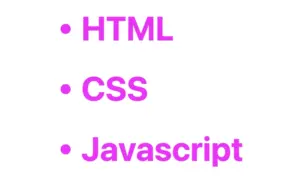
    In the associated CSS, we target the <ul> element and remove the default bullets using list-style: none. Then, we style the list items (<li>), setting their text color to magenta.

    The :before pseudo-element is used to add custom bullets before each list item. In this case, the bullet is a solid circle (•) created using the content property. The margin-right property adds spacing between the bullet and the text.

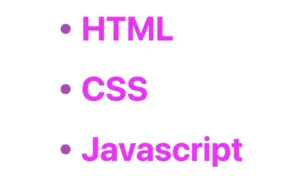
    Additionally, a grayscale effect is applied to the bullets using filter: grayscale(50%), reducing their original color intensity by 50%. This results in bullets appearing in varying shades of gray while still retaining some color.

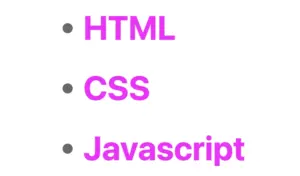
    For an even more pronounced effect, I also applied a 90% grayscale filter (filter: grayscale(90%)), making the bullets appear even closer to a true gray. 😃

    This image displays an unordered list with three list items, all styled in magenta color.
    without grayscale(%)
    This image shows an unordered list with three list items inside. The list items have color magenta while a grayscale effect is applied to the bullets using filter: grayscale(50%), rendering them with a 50% intensity of grayscale.
    with grayscale(50%)
    This image displays an unordered list with three magenta-colored list items. The bullets have the CSS grayscale filter set to 90%, making them appear in grayish shades.
    with grayscale(90%)

    CSS Grayscale on images

    Another way to take advantage of this CSS property is by applying the filter: grayscale to images, transforming their colors into shades of gray. This is particularly useful for making pictures look old-fashioned or monochromatic when they create a black and white effect.

    <div class="grayscale-image"><div>
    HTML
    .grayscale-image {
      background-image: url(<your-image>);
      background-repeat: no-repeat;
      background-size: cover;
      width: 300px;
      height: 400px;
      filter: grayscale(70%);
    }
    CSS

    The given code creates an HTML div element with the class .grayscale-image.

    This class is styled using CSS to display a grayscale image. The background of the div is set to an image from the provided URL using the background-image property. The image is styled to not repeat (background-repeat: no-repeat) and to cover the entire area (background-size: cover). Its dimensions are set to width of 300 pixels and height of 400 pixels. Finally, a grayscale filter is applied to the image using the filter property, with a 70% level of grayscale.

    This image displays a photo with vibrant colors, including shades of pink, gold, and green.
    without grayscale(%) – Original photo by Katie Harp on Unsplash
    This image displays a photo with colors close to pink, gold, and green, with the CSS grayscale filter set to 70%, partially desaturating the colors into grayish tones.
    with grayscale(70%)

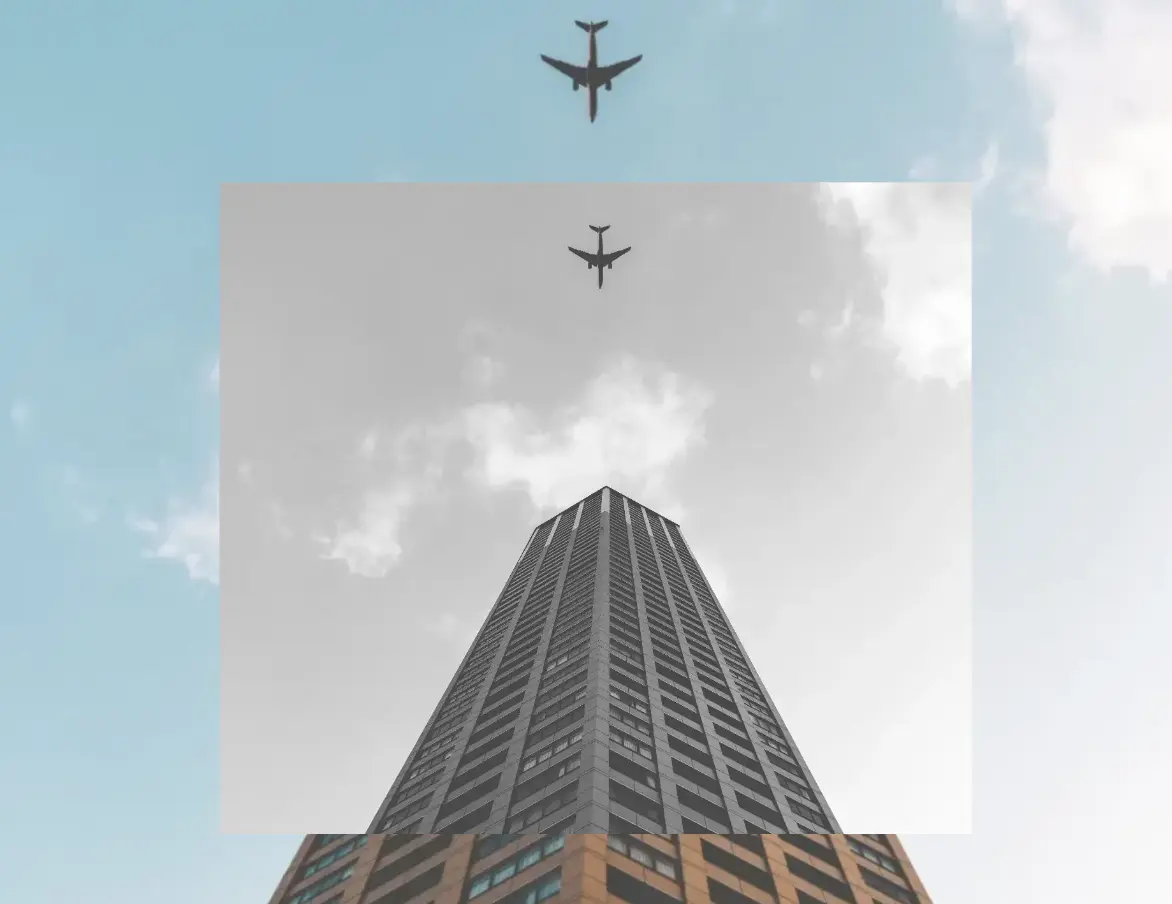
    I did something similar for the following image but set the grayscale to 100%, which transformed the image entirely into shades of gray. Impressive, isn’t it? 🙃

    This image displays a photo of a brown building with the sky in the background and an airplane flying overhead.
    without grayscale – Original photo by Sorasak on Unsplash
    This image displays a photo of a brown building and the sky with an airplane. The CSS grayscale filter is set to 100%, converting the entire photo into grayscale shades.
    grayscale(100%)

    CSS Grayscale on SVG

    The grayscale filter can be applied to SVG elements too, making them appear in varying shades of gray. This is often used to achieve a specific artistic or design effect. For instance, we applied this filter to an SVG of a moon, which was originally yellow, transforming it into a soft gray and adding a unique visual dimension. Awesome, right?

    svg {
      filter: grayscale(80%);
    }
    CSS

    In our CSS code, we apply a filter with a specified grayscale percentage of 80%. This effect transforms the originally yellow image into varying shades of gray while preserving a subtle hint of its original color.

    🔖 Remember that directly targeting the <svg> element may cause conflicts 🌩 ⚡ if multiple SVGs exist in the document.

    This image displays a yellow moon against a dark background.
    without grayscale(%)
    This image displays a yellow moon with the CSS grayscale filter set to 80%, partially desaturating the colors into grayish shades while retaining 20% of the original hue.
    with grayscale(80%)

    CSS Grayscale in Font Awesome

    Another way to use this CSS trick is with Font Awesome icons. In the example below, we will see how to do it the correct way. Since Font Awesome icons start off as black, it’s important to apply color before adding the grayscale effect.

    <i class="fa-solid fa-camera-retro"></i>
    
    HTML
    .fa-camera-retro {
      color: red;
      filter: grayscale(70%);
    }
    
    /* OR - if you want a more generic rule */
    
    i {
      color: red;
      filter: grayscale(70%);
    }
    CSS

    In this HTM snippet, we have an <i> element with the class .fa-solid .fa-camera-retro from the Font Awesome library.

    The corresponding CSS styles .fa-camera-retro, setting the icon’s color to red and applying a 70% grayscale effect. Additionally, we can also target the <i> element directly for a more generic customization.

    🔖 Remember, if you use the Font Awesome .fa-solid class for multiple icons or style them via <i>, all instances will inherit the same appearance, affecting every <i> element in the document.

    This image displays a red retro camera icon from Font Awesome.
    without grayscale
    This image displays a red retro camera icon from Font Awesome with the CSS grayscale filter set to 70%, making the red appear much darker, almost brown.
    with grayscale(70%)

    CSS Grayscale on emoticons using pseudo-elements

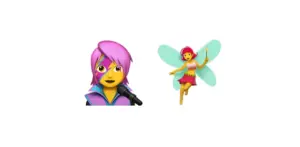
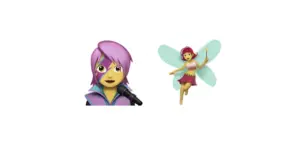
    Next, we move on to the beloved emoticons (like 🤗, 😇, etc.). It’s a cool way to make them look a bit different! Below I crafted an example to give a clearer explanation. I chose two of my favorite emoticons 👩‍🎤 🧚‍♀️. Feel free to choose your personal favorite and enjoy the experience!! Always remember that the more vivid the colors, the stronger and more noticeable the effect will be! Good luck! 🌟 🥳

    <div class="grayscale-emoticons"></div>
    HTML
    .grayscale-emoticons:before {
      content: "👩‍🎤 🧚‍♀️";
      filter: grayscale(40%);
      font-size: '50px';
    }
    CSS

    The HTML snippet creates a div element with the class .grayscale-emoticons.

    The linked CSS code, .grayscale-emoticons uses the :before pseudo-element to insert content. The inserted content consists of two emojis: “👩‍🎤” and “🧚‍♀️.” Additionally, a grayscale filter of 40% is applied, giving the emojis a subtle grayscale effect, displaying them in varying shades of gray while retaining some of their original colors.

    I also included another example with a 100% grayscale filter, which completely removes all colors, rendering the emojis entirely in grayscale.

    This image shows two colorful emoticons.
    without grayscale
    This image shows two colorful emoticons with a grayscale filter of 40%. As a result the emoticons are now displayed in varying shades of gray with 40% intensity of the original colors.
    with grayscale(40%)
    This image shows two colorful emoticons with a grayscale filter of 100%. As a result the emoticons are now displayed only in shades of gray.
    with grayscale(100%)

    Using shades of gray adds a nice touch, but if you want to go the extra mile 🏃‍♀️, try adding shadows to elements for a more realistic look. Building on our previous example, I’ve incorporated the fantastic drop-shadow CSS property to achieve this. Pretty cool, right! 😃

    .grayscale-emoticons:before {
      content: "👩‍🎤 🧚‍♀️";
      filter: grayscale(40%) drop-shadow(2px -1px 1px #1d1e22);
      font-size: 100px;
    }
    CSS
    This image displays two colorful emoticons with the CSS grayscale filter set to 40%, partially desaturating their colors. They also feature a 2px -1px 1px gray shadow.
    filter: grayscale(40%) drop-shadow(2px -1px 1px #1d1e22);
    This image shows two colorful emoticons with a grayscale filter of 100%. As a result the emoticons are now displayed in various shades of gray. They also have a 2px -2px 2px gray shadow.
    filter: grayscale(100%) drop-shadow(2px -2px 2px #1d1e22);

  • Make a Unique Folded Corner Effect Utilizing the clip-path CSS Property

    Make a Unique Folded Corner Effect Utilizing the clip-path CSS Property

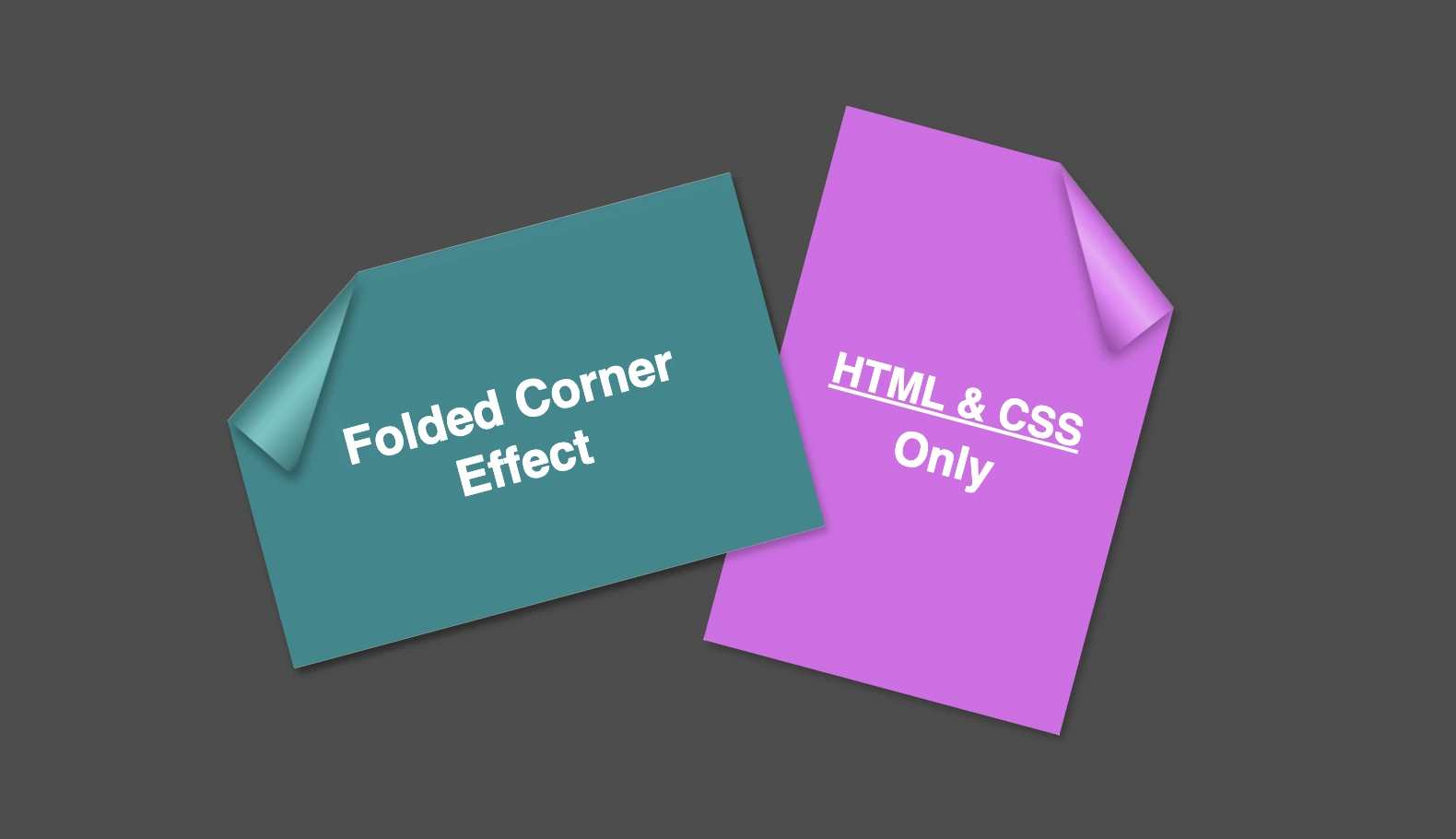
    Hello everybody! I’m excited to share a cool folded corner effect I created using just HTML and CSS. This eye-catching design adds a dynamic flair, creating a realistic illusion that enhances your webpage’s visual appeal —no images, extra scripts, or complex code required. How awesome is that? 😎

    Elements with clip-path do not take shadows directly. Instead, they must be nested within a container to inherit its shadows.

    Creating the folded corner effect using pseudo-element

    We’ll start by using the :before pseudo-element combined with the clip-path property to create the folded corner effect. The main element, which contains the pseudo-element, is styled with a filter property to apply a shadow. This shadow is then inherited by the pseudo-element, allowing the folded corner to display a subtle, realistic shadow as well. This technique keeps the design lightweight and visually appealing.

    Basic HTML structure for the folded corner effect

    The HTML code snippet creates a card layout. We have a parent element with the class .card, housing two child elements: the first with the class .title for the card’s title, and the second with the class .folded-corner to apply the folded corner effect via CSS.

    <div class="card">
      <div class="title">Folded Corner Effect</div>
      <div class="folded-corner"></div>
    </div>
    HTML

    CSS structure: creating the paper and cut corner

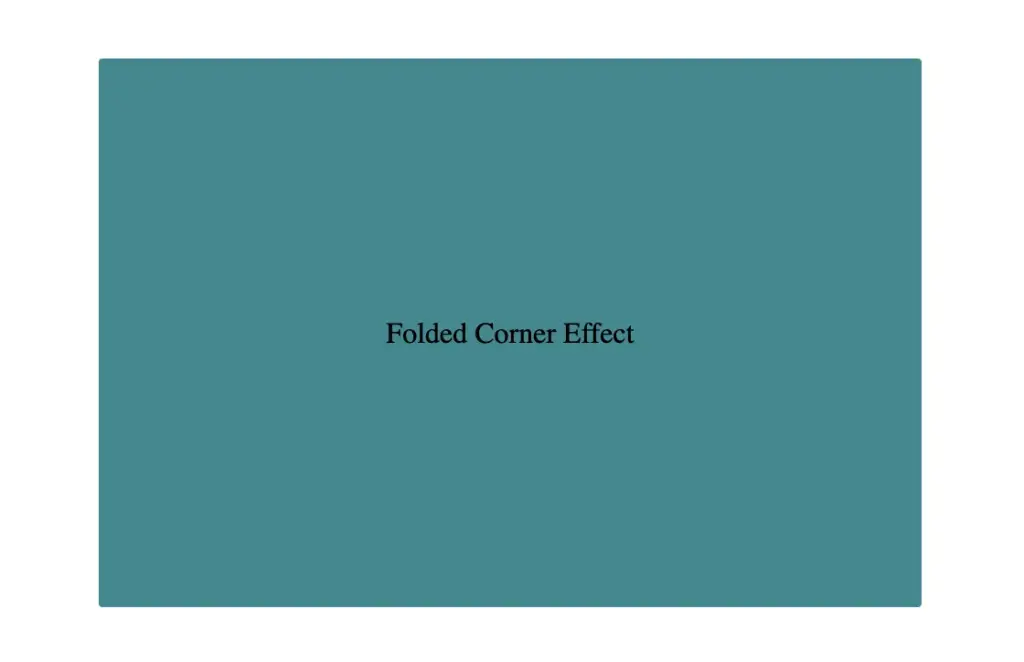
    Starting with the CSS, we define a horizontal rectangle by setting the width to 450px and the height to 300px, along with a subtle 2px border-radius for slightly rounded corners. The background color is set to #228a90, a rich teal with greenish-blue tones that gives the card a fresh, modern look.

    .card {
      width: 450px;
      height: 300px;
      border-radius: 2px;
      background-color: #228a90;
        
      display: flex;
      align-items: center;
      justify-content: center;
    }
    CSS
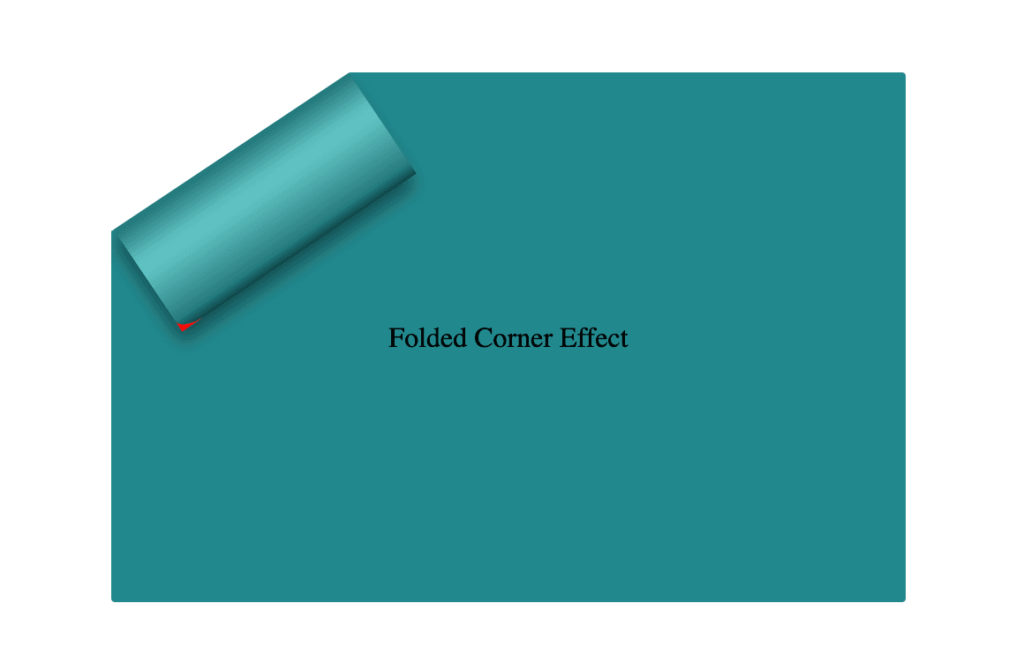
    Initial paper design before applying folded corner effect

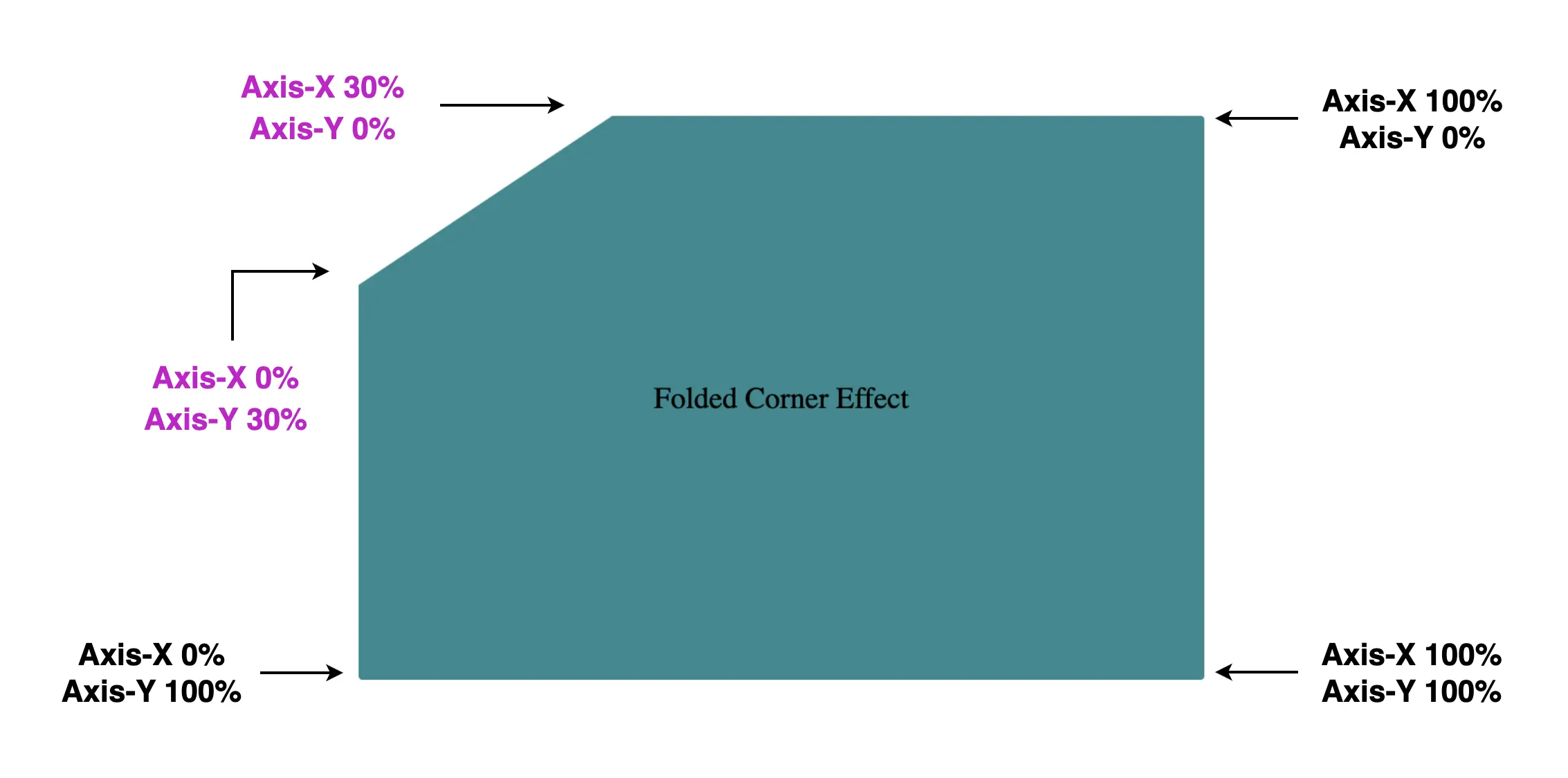
    Then we use the clip-path property to shape the desired paper corner for the folded effect. I chose the top-left corner, but you can select any one you prefer by adjusting the corresponding points in the clip-path: polygon() function.

    .card {
      width: 450px;
      height: 300px;
      border-radius: 2px;
      background-color: #228a90;
      
      clip-path: polygon(0% 30%, 30% 0%, 100% 0%, 100% 100%, 0% 100%);
      position: relative;
    }
    CSS

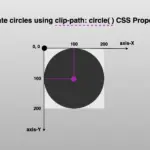
    Think of the corners in this order: top-left, top-right, bottom-right, bottom-left (clockwise).

    Remember to split each selected corner into two coordinates to get the right look (watch those 👇 magenta measurements! 😉)
    Take into account that the top-left corner has both Axis-X and Axis-Y on 0%.

    Axis coordinates of card showing top-left corner cut, preparing the folded corner effect

    Finally, adding position:relative does not change something in our effect but prepares us for future positioning adjustments. As for centering our elements using flexbox—it’s purely for aesthetic purposes, helping keep everything visually balanced and neat.
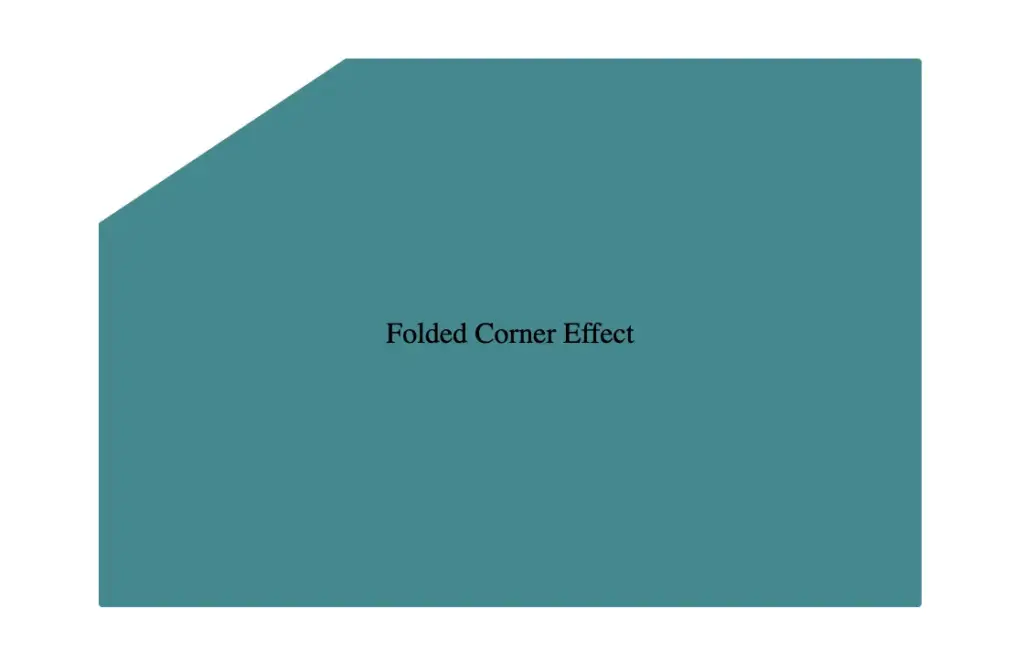
    Below, we can see what is rendered on the screen for now. Pretty cool, right!? 😃

    Progress so far: paper with cut corner created using HTML and CSS folded corner effect

    CSS structure: how to create the folded corner effect

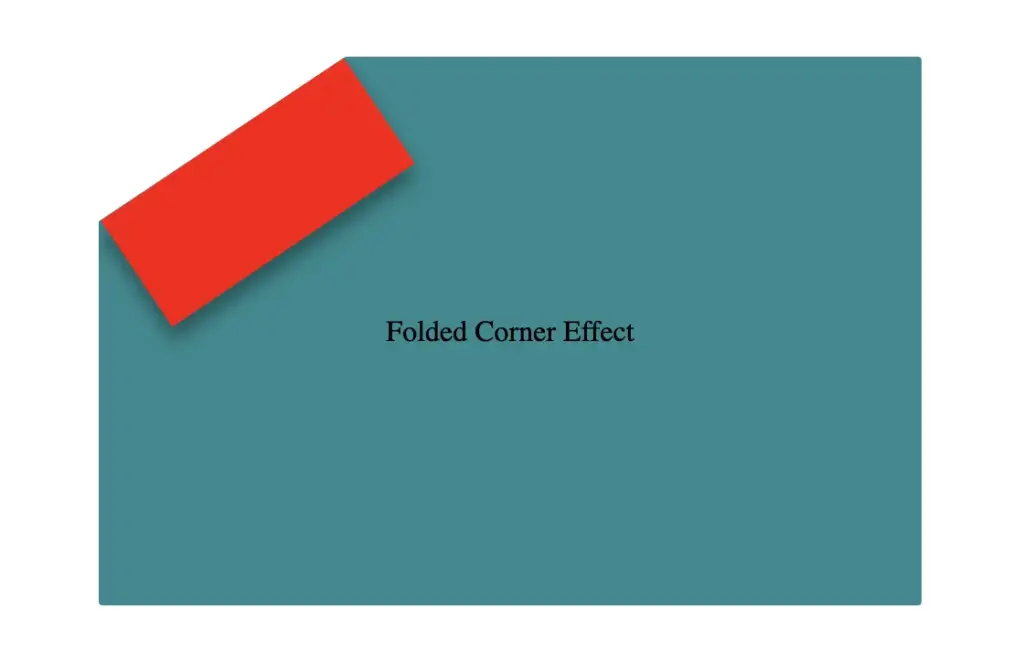
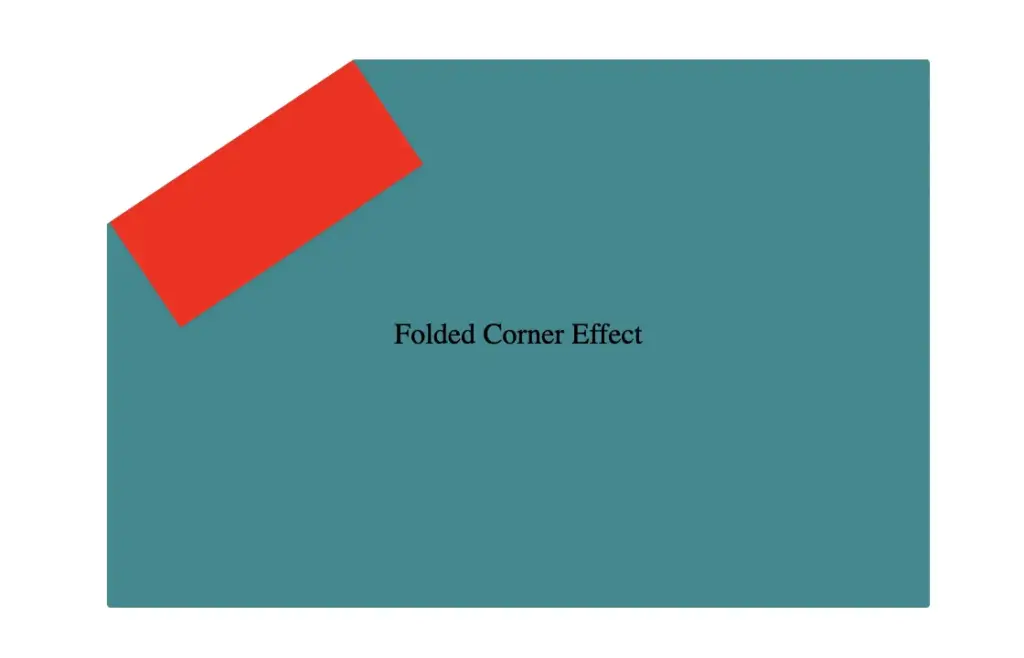
    To continue building our effect, we’ll use the folder-corner child element to create a second rectangle within the parent card element. This element will act as the folded piece of paper. We’ll give it a width of 70px and a height of 160px.

    .card .folded-corner {
      width: 70px;
      height: 160px;
      background-color: red;
      position: absolute;
    }
    CSS

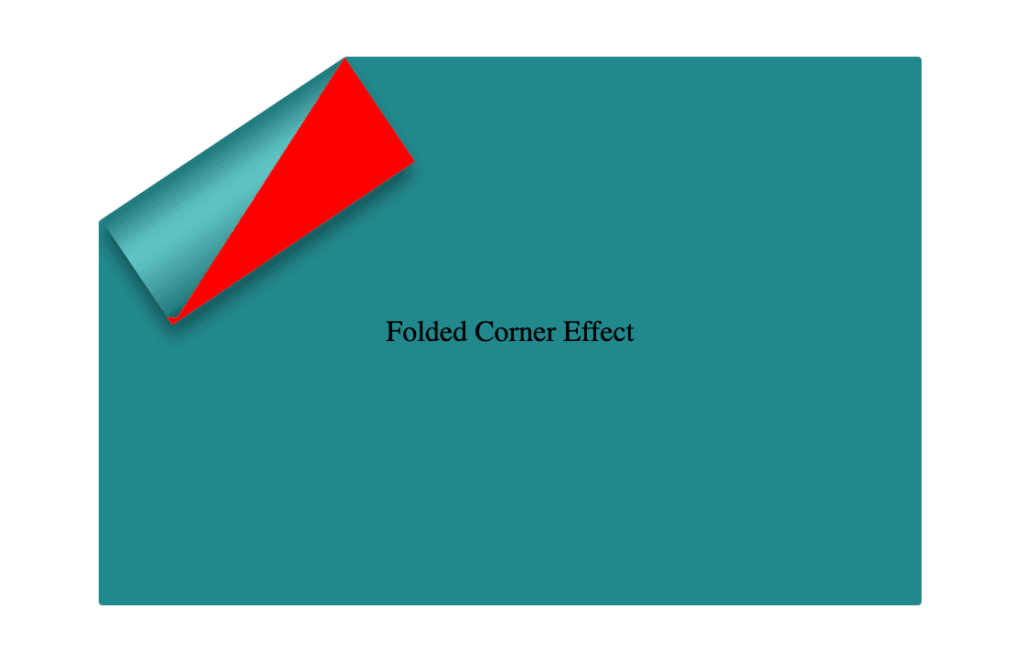
    For now, we’ll use a red background color to help us visualize its position and behavior more clearly—this will be updated to its final color later. We’ll also apply position: absolute to enable precise positioning.

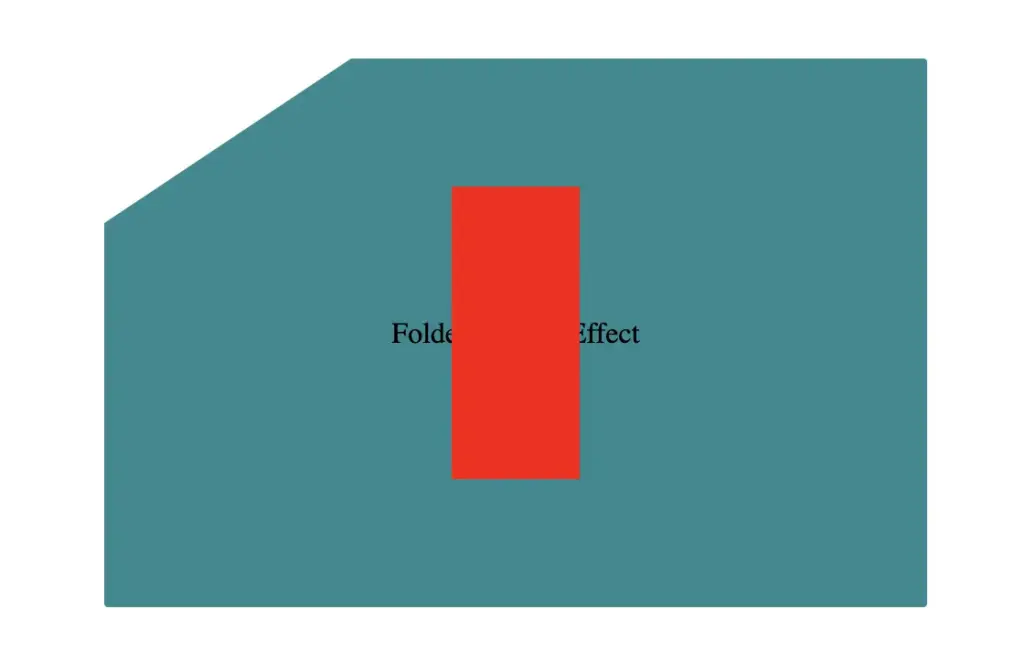
    Initial red-colored container element for folded corner effect

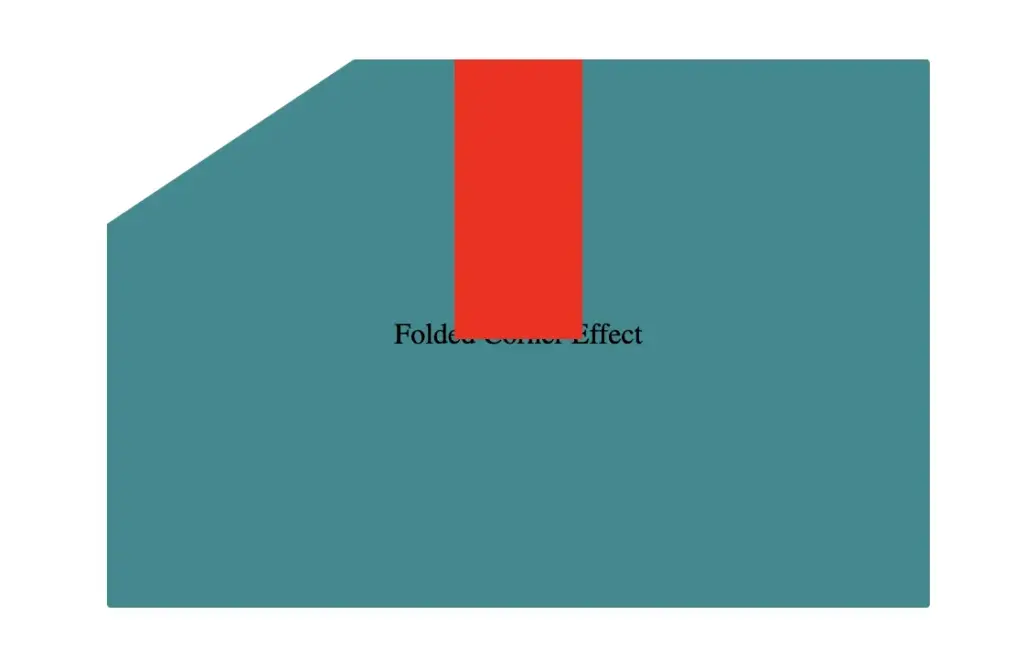
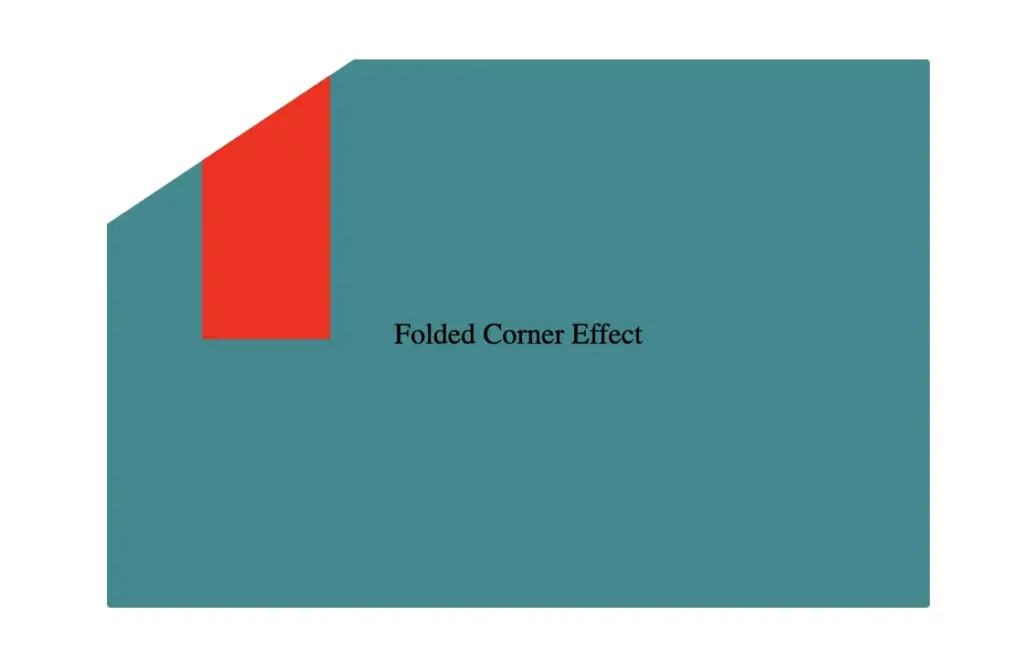
    Next, we continue with positioning. We use the top and left properties to move the .folded-corner element closer to the clipped corner, then apply the transform property to rotate it into place.

    .card .folded-corner {
      ...
      top: -7px;
      left: 52px;
      transform: rotate(56deg);
    }
    CSS
    Positioning folded-corner element at top -7px in folded corner effect layout
    top: -7px;
    Positioning folded-corner element at left 52px to align with cut corner
    left: 52px;
    Rotating folded-corner element by 52 degrees using CSS transform property
    transform: rotate(56deg);

    Finally, adding the filter property is essential for completing our effect. As mentioned earlier, applying a shadow directly to an element with a clip-path isn’t possible — so the solution is to create an additional element that can hold the shadow.

    To do this, we’ll add a :before pseudo-element with the same dimensions as our folded corner. This allows us to recreate the folded shape and apply the shadow to it — adding depth and realism to the folded corner effect. 😎

    .card .folded-corner {
      ...
      top: -7px;
      left: 52px;
      transform: rotate(56deg);
      filter: drop-shadow(6px 4px 5px rgba(0, 0, 0, 0.4));
    }
    CSS
    Initial red-colored container element for folded corner effect
    filter: drop-shadow(6px 4px 5px rgba(0, 0, 0, 0.4));

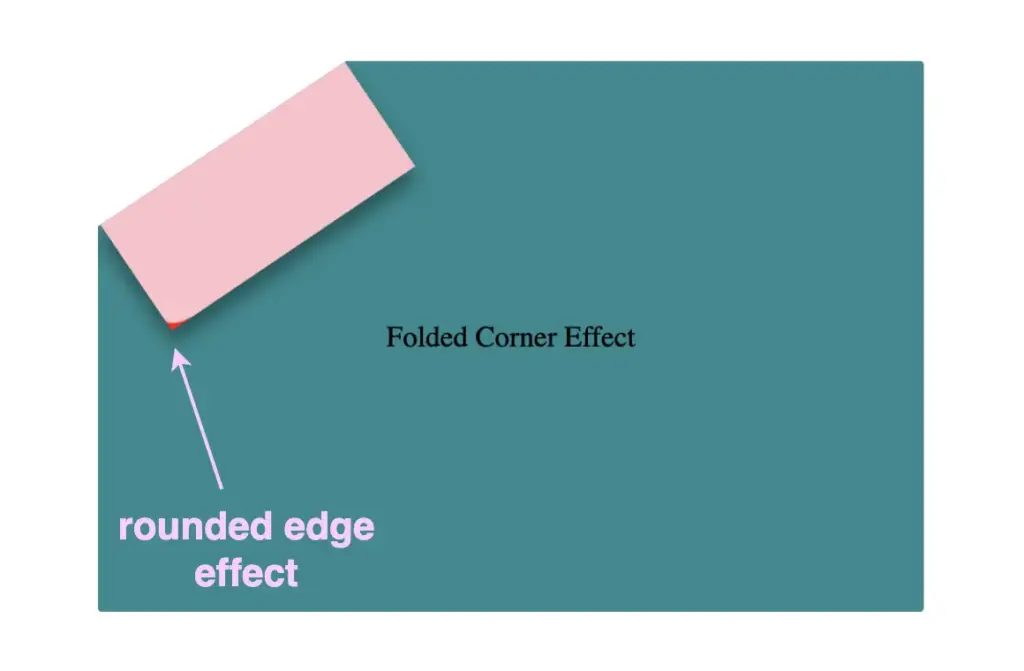
    Next, we move forward by using the before pseudo-element with the content property and set its position to absolute for precise placement within the parent.
    We want this pseudo-element to have the exact dimensions as the parent, so we set both its width and height to 100%, something that allows it to inherit the parent’s size.

    .card .folded-corner:before {
      content: "";
      position: absolute;
      width: 100%;
      height: 100%;
      background: pink;
      border-radius: 0 0 10% 0;
    }
    CSS

    For now, we apply a pink background to help visualize the structure. Finally, we add a border-radius of 10% to the bottom corner, which softens the edge and creates a smoother, more realistic folded appearance.

    Adding the before pseudoelement

    Next, we replace the pink background with a smooth linear gradient. We choose colors similar to the main hue but make them darker towards the edges and lighter in the center. This gradient effect enhances the appearance by making the center appear brighter and polish. ✨

    .card .folded-corner:before {
      ...
      background: linear-gradient(to right, #277c7f 5%, #5abcbc 30%, #63c5c6 40%, #5abcbc 50%, #277c7f 90%, #0d4749);
    }
    CSS
    Adding linear- gradient at the before pseudoelement

    To complete the shape, we apply the clip-path: polygon(0% -2%, 0% 100%, 100% 100%) property. This is essential for transforming the before pseudo-element —which starts as a rectangle, just like its parent—into a triangle.

    In simple words, this clipping path reshapes the element into the desired triangular form. 🥳

    .card .folded-corner:before {
      ...
      clip-path: polygon(0% -2%, 0% 100%, 100% 100%);
    }
    CSS
    Adding clip-path to the before pseudoelement

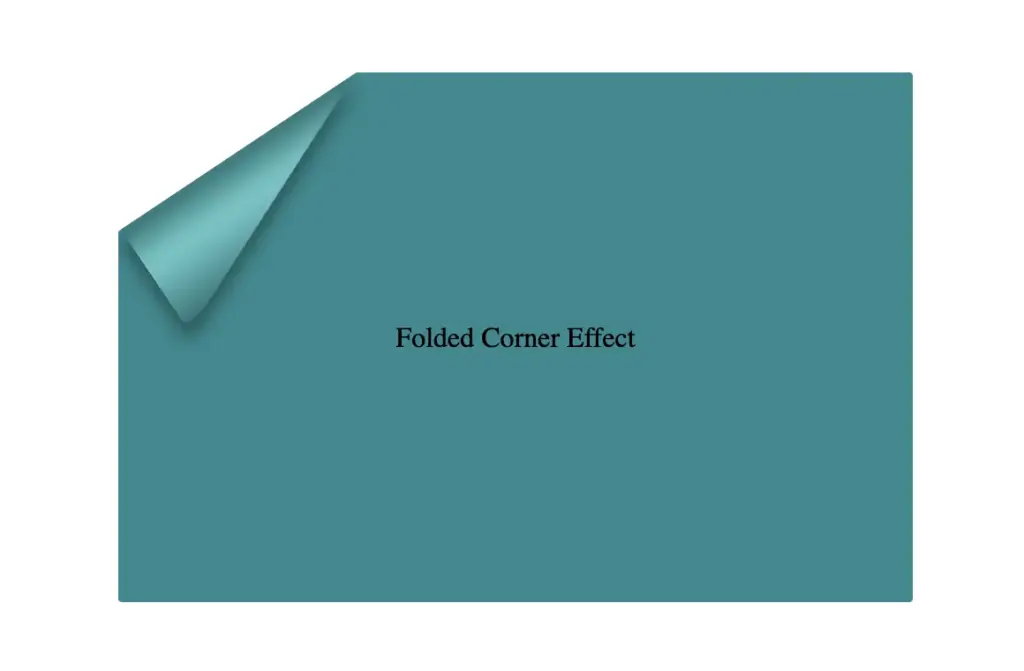
    The last step is to turn back to the parent element with the class .folded-corner and “remove” the red rectangle from view by simply replacing the red background-color with a transparent value.
    As we can see, the :before pseudoelement inherits its parent shadow effect while the parent becomes invisible.

    .card .folded-corner {
      width: 70px;
      height: 160px;
      background-color: transparent;
      position: absolute;
      top: -7px;
      left: 52px;
      transform: rotate(56deg);
      filter: drop-shadow(6px 4px 5px rgba(0, 0, 0, 0.4));
    }
    CSS
    Finalize the folded corner effect

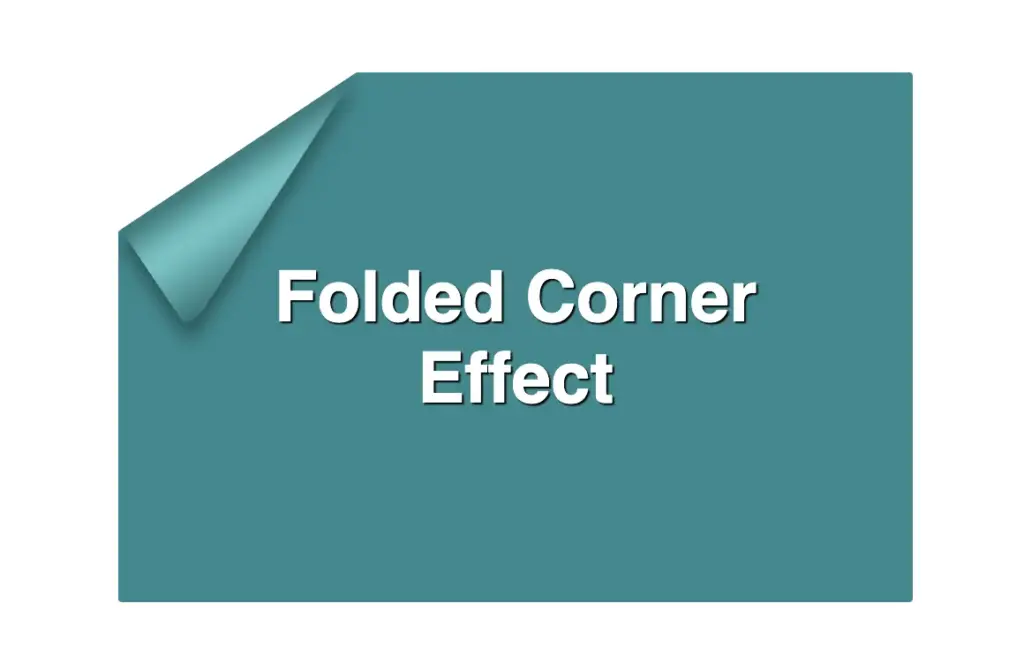
    We can enhance the title to have a more eye-cathing result. Applying a white background-color, increasing the font-size, and adding a subtle black text-shadow will make the title stand out beautifully, elevating the overall design. 📄 ✨

    .card .title {
      font-family: sans-serif;
      font-size: 40px;
      font-weight: bold;
      text-align: center;
      padding: 0 50px;
      color: white;
      text-shadow: 1px 1px 1px black;
    }
    CSS
    Stylling paper's title

    Complete code example

    <div class="card">
      <div class="title">Folded Corner Effect</div>
      <div class="folded-corner"></div>
    </div>
    HTML
    .card {
      width: 450px;
      height: 300px;
      border-radius: 2px;
      background-color: #228a90;
      clip-path: polygon(0% 30%, 30% 0%, 100% 0%, 100% 100%, 0% 100%);
      position: relative;
      display: flex;
      align-items: center;
      justify-content: center;
    }
    
    .card .folded-corner {
      width: 70px;
      height: 160px;
      background-color: transparent;
      position: absolute;
      top: -7px;
      left: 52px;
      transform: rotate(56deg);
      filter: drop-shadow(6px 4px 5px rgba(0, 0, 0, 0.4));
    }
    
    .card .folded-corner:before {
      content: "";
      position: absolute;
      width: 100%;
      height: 100%;
      border-radius: 0 0 10% 0;
      background: linear-gradient(to right, #277c7f 5%, #5abcbc 30%, #63c5c6 40%, #5abcbc 50%, #277c7f 90%, #0d4749);
      clip-path: polygon(0% -2%, 0% 100%, 100% 100%);
    }
    
    .card .title {
      font-family: sans-serif;
      font-size: 40px;
      font-weight: bold;
      text-align: center;
      padding: 0 50px;
      color: white;
      text-shadow: 1px 1px 1px black;
    }
    CSS
    Expand

    If you have any questions or run into any issues, don’t hesitate to reach out in the comments below — I’m happy to help. You can easily copy any code snippet by clicking the copy icon in the top-right corner of each block.

    Summary

    We started by creating the paper and cutting its corner. Then, we set the clip-path property to define the shape and positioned the folded-corner element precisely over the clipped area. After that, we enhanced the styling with background gradients that match the paper’s tone, and wrapped up by polishing the effect for a clean, realistic look. 📄 ✨

    Wishing you the best of luck in all your creative endeavors! 😃

  • Opacity And Saturate: Empower CSS Filter For Unique Images

    Opacity And Saturate: Empower CSS Filter For Unique Images

    Welcome to a practical guide on using the CSS filter to modify how your images 📸 look. In this post, we’ll work on how to adjust the opacity and saturate (color intensity) CSS filters. These two methods will help us handle how images are rendered on our website, particularly concerning their colors and transparency.

    Let’s get into the world of CSS 👩‍💻 and customize the images to suit our needs.

    CSS filter: opacity

    The CSS property filter: opacity() helps you control how colorful an image appears against its background. You can set it anywhere between 0% and 100%. At 0%, the image turns grayscale, losing all its colors and showing only the background color. If you set it to 100%, the image displays its true, unaltered colors. Values in between change how colorful the image appears.

    🔖 For setting CSS opacity, you can use either a percentage of 0% and 100% or a decimal value between 0 and 1, both options ending up in the same outcome. 🫧😃

    Example

    Starting with the HTML code which includes three <img> elements. All images share the same .image class. Additionally, the second image includes one more class the .opacity-image2 while the third image includes the .opacity-image3 class.

    <body>
      <img class="image"/>
      <img class="image opacity-image2"/>
      <img class="image opacity-image3"/>
    </body>
    HTML

    In the CSS code the .image class introduces a non-repeated image that covers the entire background area of the element. Its dimensions are 300 pixels in width and 500 pixels in height.

    We move forward with the other two classes. The .opacity-image2 class targets the second image and applies a visual effect controlling transparency. An opacity of 80% means the element will be slightly transparent, allowing some background to show through.

    The .opacity-image3 class is meant for the third image, ensuring the same visual change happens there too. In this case, an opacity of 20% means the element will be mostly transparent, allowing more background to show through.

    .image {
      background-image: url(https://images.unsplash.com/photo-1501829385782-9841539fa6bf?ixlib=rb-4.0.3&ixid=M3wxMjA3fDB8MHxwaG90by1wYWdlfHx8fGVufDB8fHx8fA%3D%3D&auto=format&fit=crop&w=3024&q=80);
      background-repeat: no-repeat;
      background-size: cover;
      width: 300px;
      height: 500px;
    }
    
    .opacity-image2 {
      filter: opacity(80%);
    }
    
    .opacity-image3 {
      filter: opacity(20%);
    }
    CSS

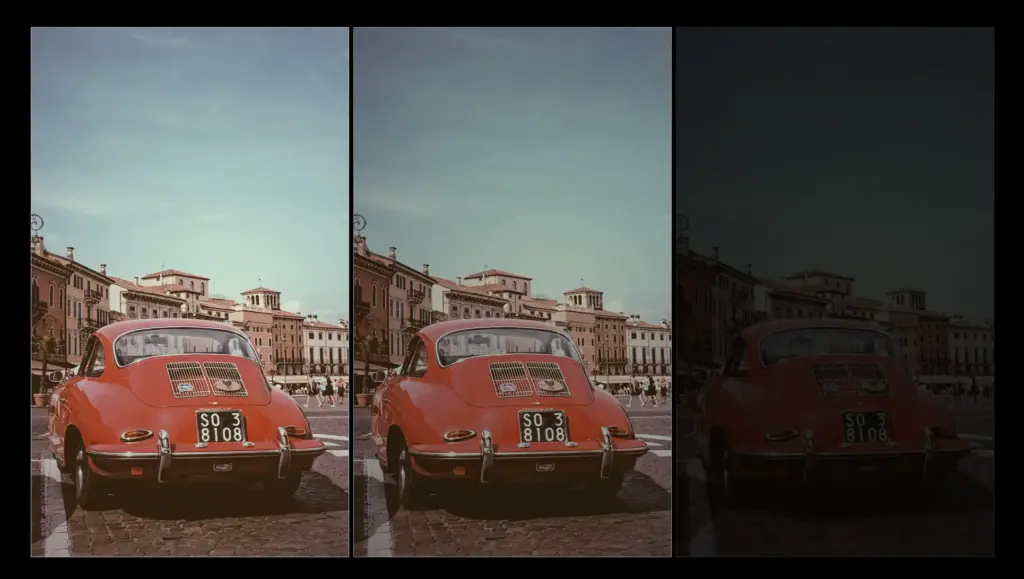
    * In this case, the background is black, so our effect turns to dark shades.

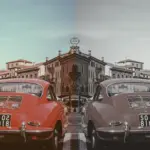
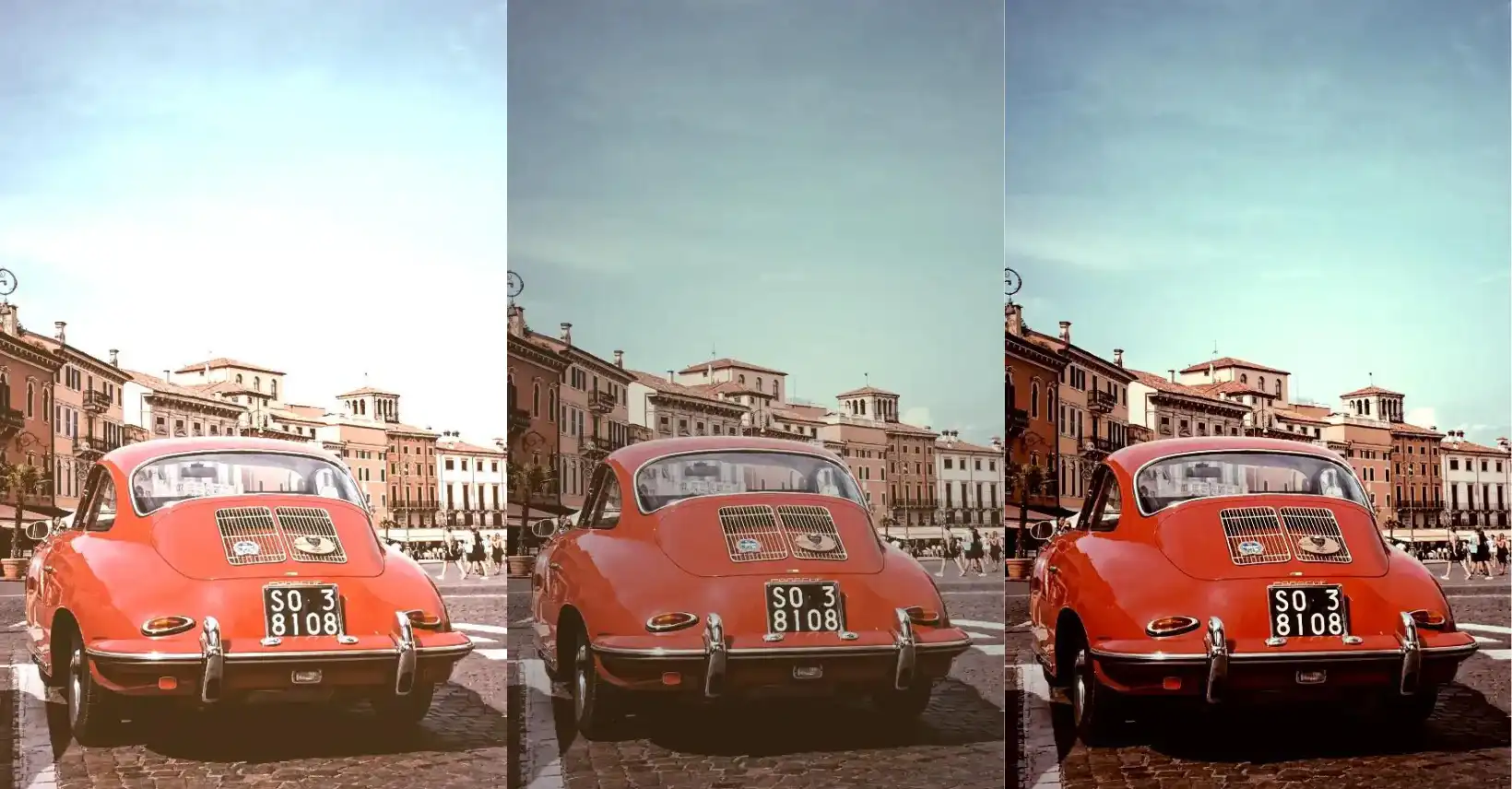
    Three identical photos of a red car with old buildings in Verona city, Italy. The first photo displays original colors. The second has opacity set to 80%, and the third has opacity set to 20%. The white background affects the opacity.
    Original Photo by Jonatan Hernandez on Unsplash – opacity(80%) – opacity(20%)

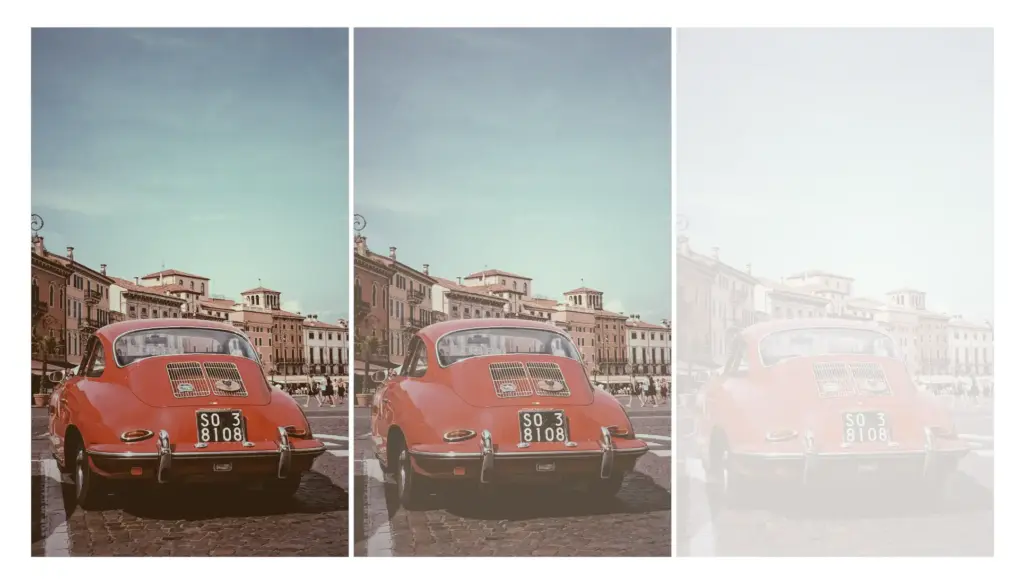
    * In this case, the background is white, so our effect turns to bright shades.

    This image shows three identical photos. All photos shown a red car with old buildings as a background.This photo was captured in Verona city Italy. The first photo has the original colors. The second has set the filter: opacity(80%); CSS property while the third has set the filter: opacity(20%);. Additionally the background has color white which affects the opacity.
    Original photo by Jonatan Hernandez on Unsplash – opacity(80%) – opacity(20%)

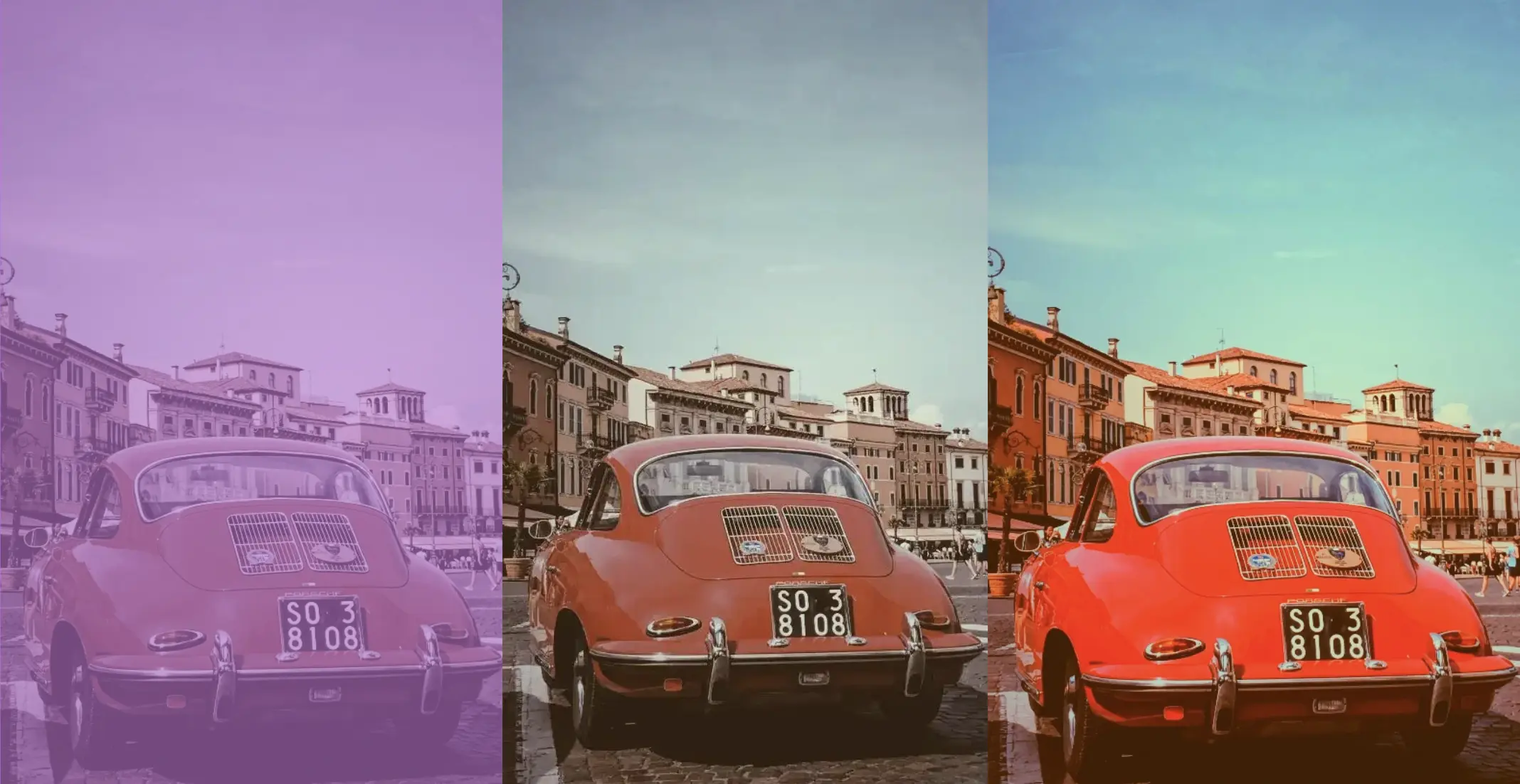
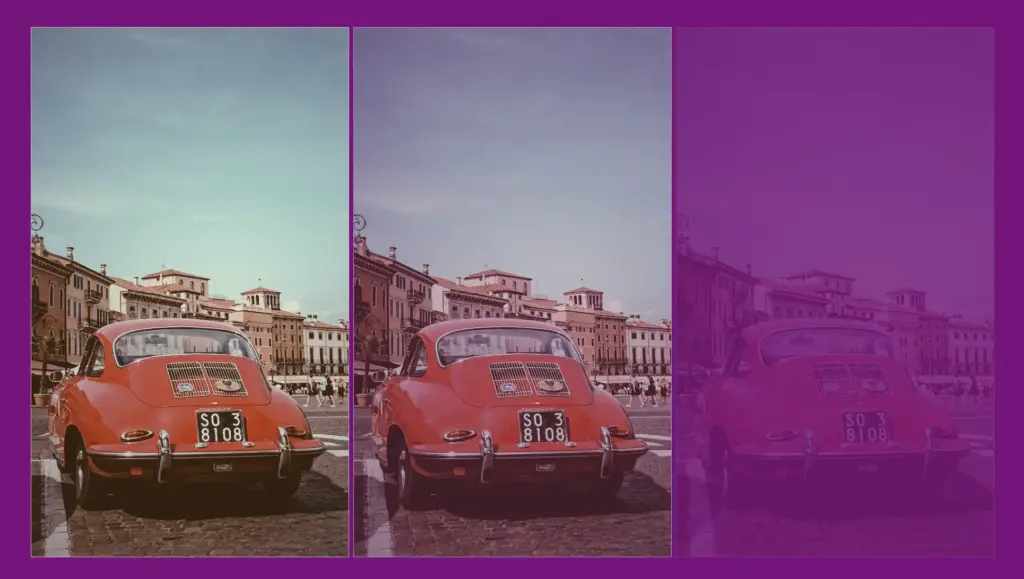
    * In this case, the background is purple (a random color for this specific example, as you can pick any color you prefer), so our effect will blend the original element’s colors and the purple background color, influenced by the 80% opacity.

    Red car with old buildings in Verona city, Italy, demonstrating CSS opacity filter effects. Three photos: original colors, 80% opacity, and 20% opacity against a purple background.

    Original photo by Jonatan Hernandez on Unsplash – opacity(80%) – opacity(20%)

    CSS filter: saturate

    Saturation is about how bright and vivid colors are in a picture. The CSS property filter: saturate() helps you adjust this. The values vary from 0% to 100%. If you choose 0%, the colors disappear and become black and white (grayscale). With a value of 100%, it stays as colorful as it was.

    Keep in mind that going over 100% makes colors appear highly vibrant. Specifying a saturation of 200% is technically allowed, but that’s not the usual way.

    🔖 To specify a percentage for saturation, you can use values like 10% or 0.1, they mean the same thing. It’s up to you. 🫧😃

    Example

    Starting with the HTML code which includes three <img> elements. All images share the same .image class. Additionally, the second image includes one more class the .saturate-image2 while the third image includes the .saturate-image3 class.

    <img class="image"/>
    <img class="image saturate-image2"/>
    <img class="image saturate-image3"/>
    
    HTML

    In the CSS code, the .image class introduces a non-repeated image that covers the entire background area of the element. Its dimensions are 300 pixels in width and 500 pixels in height.

    We continue with the other two classes. The .saturate-image2 class targets the second image and applies a visual effect controlling saturation. A saturation of 200% will be doubled compared to the original colors of the image, resulting in a sharp visual effect.

    The .saturate-image3 class focuses on the third image and applies the same visual effect. In this case, a saturation of 20% means the image will have its colors slightly desaturated, resulting in a toned-down appearance compared to the original colors. The saturation level will be reduced to one-fifth of the original, giving a less intense color effect.

    .image {
      background-image: url(https://images.unsplash.com/photo-1501829385782-9841539fa6bf?ixlib=rb-4.0.3&ixid=M3wxMjA3fDB8MHxwaG90by1wYWdlfHx8fGVufDB8fHx8fA%3D%3D&auto=format&fit=crop&w=3024&q=80);
      background-repeat: no-repeat;
      background-size: cover;
      width: 300px;
      height: 500px;
    }
    
    .saturate-image2 {
      filter: saturate(200%);
    }
    
    .saturate-image3 {
      filter: saturate(20%);
    }
    CSS

    The results are shown in the images below.

    Red car with old buildings in Verona city, Italy
    default-saturate(100%) Original photo by Jonatan Hernandez on Unsplash
    Vibrant red car against old buildings in Verona city, Italy, with CSS saturate filter set to 200%.
    saturate(200%)
    Red car against old buildings in Verona city, Italy, with CSS saturate filter set to 20%, resulting in a more grayish appearance compared to the original photo.
    saturate(20%)
  • CSS Filters: Adjust Contrast and Brightness

    CSS Filters: Adjust Contrast and Brightness

    Welcome to a practical guide on using CSS filter to modify the appearance of your 📸 images. In this post, we’ll focus on adjusting the contrast and brightness CSS filters. These techniques will allow us to control how images are displayed, specifically regarding their levels of light and darkness.

    Let’s dive into the world of CSS 👩‍💻 and customize the images to suit our preferences.

    CSS property filter: contrast

    The CSS property filter: contrast() is used to control the difference between the light and dark parts of an image. The contrast property accepts values from 0% to infinity. A value of 100% (or 1) is normal contrast. A higher value, increases the difference between light and dark areas, making the image appear more vivid and clearer. On the contrary, a lower value decreases the distinction, resulting in a softer and more blended appearance.

    Always remember, if you want your picture to be clear and detailed, you can try using higher contrast values. This way, you find the right mix between making the picture softer and keeping it sharp and clear. But if you set the contrast too low, the picture might not show the different parts or details well. It might look a bit boring or like it has a gray layer on top. 🙁

    🔖 You can express contrast either as a percentage (10%) or in decimal form (0.1) – both methods produce identical results. The choice between the two is entirely based on your personal liking. 🫧😃

    CSS Contrast filter example

    I crafted an example for you.

    Starting with the HTML code which includes three <img> elements. All images share the same .image class. Additionally, the second image includes one more class the .contrast-image2 while the third image includes the .contrast-image3 class.

    <img class="image"/>
    <img class="image contrast-image2"/>
    <img class="image contrast-image3"/>
    HTML

    In the CSS code the .image class introduces a non-repeated image that covers the entire background area of the element. Its dimensions are 300 pixels in width and 500 pixels in height.

    We move forward with the other two classes. The .contrast-image2 class targets the second image and applies a visual effect that controls the contrast. A value of 150% would make the differences between light and dark elements in the image more pronounced, resulting in a sharper and more defined visual appearance.

    The .contrast-image3 class targets the third image and applies the same visual effect. In this case, a value of 20% reduces the contrast, making it less distinct and blending the light and dark areas.

    .image {
      background-image: url(https://images.unsplash.com/photo-1501829385782-9841539fa6bf?ixlib=rb-4.0.3&ixid=M3wxMjA3fDB8MHxwaG90by1wYWdlfHx8fGVufDB8fHx8fA%3D%3D&auto=format&fit=crop&w=3024&q=80);
      background-repeat: no-repeat;
      background-size: cover;
      width: 300px;
      height: 500px;
    }
    
    .contrast-image2 {
      filter: contrast(150%);
    }
    
    .contrast-image3 {
      filter: contrast(20%);
    }
    CSS

    In the images below we can see the results.

    CSS property filter: brightness

    The CSS filter: brightness is a property that adjusts the intensity of light in an image. It influences how bright or dark the visual element appears to the viewer. A value of 100% (or 1) represents the origin brightness. Values less than 100% darken the element, while values greater than 100% brighten it. For example, 50% would make the element half as bright, and 200% would make it twice as bright while a brightness of 0% gives only a black color.

    🔖 You have the choice to indicate brightness using percentages, such as 10%, or in decimal form like 0.1, both have the same results. It’s completely up to your preference. 🫧😃

    CSS Brightness filter example

    Here is an example for you.

    Starting with the HTML code which includes three <img> elements. All images share the same .image class. Additionally, the second image includes one more class the .brightness-image2 while the third image includes the .brightness-image3 class.

    <img class="image"/>
    <img class="image brightness-image2"/>
    <img class="image brightness-image3"/>
    HTML

    In the CSS code the .image class introduces a non-repeated image that covers the entire background area of the element. Its dimensions are 300 pixels in width and 500 pixels in height.

    We proceed with the other two classes. The .brightness-image2 class targets the second image and applies a visual effect that controls the brightness making the element 1.5 times brighter than its normal appearance.

    The .brightness-image3 class targets the third image and applies the same visual effect. In this case, a brightness of 20% means the element will be darkened, making it one-fifth as bright as its original state.

    .image {
      background-image: url(https://images.unsplash.com/photo-1501829385782-9841539fa6bf?ixlib=rb-4.0.3&ixid=M3wxMjA3fDB8MHxwaG90by1wYWdlfHx8fGVufDB8fHx8fA%3D%3D&auto=format&fit=crop&w=3024&q=80);
      background-repeat: no-repeat;
      background-size: cover;
      width: 300px;
      height: 500px;
    }
    
    .brightness-image2 {
      filter: brightness(150%);
    }
    
    .brightness-image3 {
      filter: brightness(20%);
    }
    CSS

    In the images below we can see the results.

  • Using CSS Opacity for Transparency

    Using CSS Opacity for Transparency

    The CSS opacity filter is a property that allows you to adjust the transparency of an element on a website. Opacity values range from 0.0 to 1 (default), where opacity: 0.0 indicates complete transparency and opacity: 1 indicates complete intransparency (opaqueness). 👻💻

    How to change opacity on hover?

    You can create visually appealing effects by overlapping the elements’ colors. Moreover, you can make it more dynamic 💥 by animating it with CSS transitions. For instance, you can create an effect when an element is clicked or hovered over.

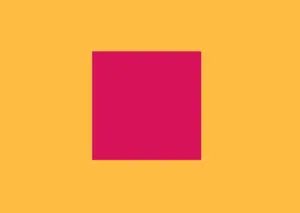
    Let’s say, for example, we have a red box like this

    A magenta box on an orange background

    and would like to change its opacity on hover. How would we do that? We would add the following code:

    .box:hover {
      opacity: 0.5;
    }
    CSS

    As a result, when hovering over our element, it would change its opacity like this

    See the Pen
    Opacity box no transition
    by George (@GeorgeLin)
    on CodePen.

    Some may think this is not ideal; changing the opacity is cool, but it feels like we can do better. A straightforward way to improve the opacity change is just to add a transition effect and make it look much cooler:

    .box {
      transition: opacity 0.5;
    }
    .box:hover {
      opacity: 0.5;
      transition: opacity 0.5;
    }
    CSS

    We apply the same transition to both the .box class and its hover state to ensure a consistent effect when hovering on or off the element. This approach produces the following result:

    See the Pen
    Opacity box with transition
    by George (@GeorgeLin)
    on CodePen.

    Pretty cool, right?

    Exploring CSS Opacity and Its Impact on Background Colors in HTML

    Depending on the opacity value, the child’s hues are influenced by the parent’s colors. Hues become more vibrant as the opacity/transparency increases. If the child element has a low opacity value, its colors will be more similar to the parent’s background-color. Conversely, if the child element has a high opacity value, its colors will be less similar to the parent’s color.

    In the following examples I prepared, we can see how this CSS property works. 🧐 So, let’s take a closer look.

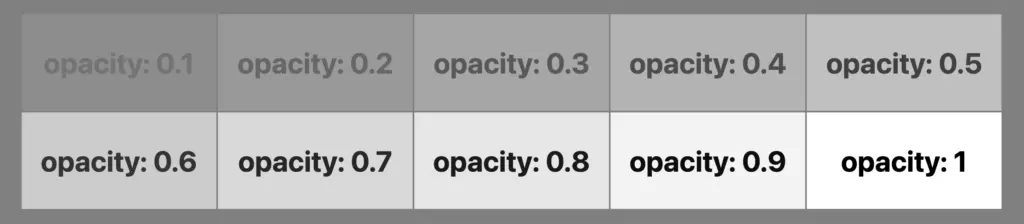
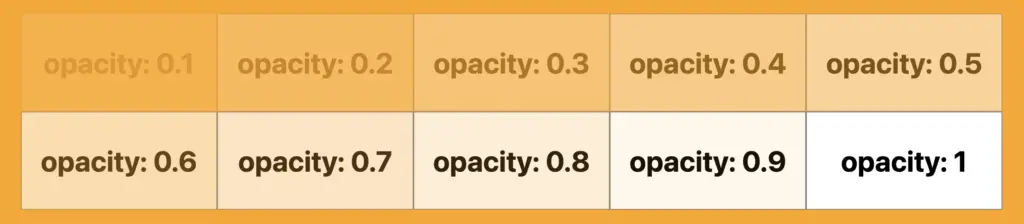
    Each example has a pair of HTML elements, one with .parent class and one with the .child class. Child elements have the same colors (color: black and  background-color: white) while parent elements have different background-color each time (gray and orange).

    CSS Opacity: Effects on HTML Elements with Gray Backgrounds

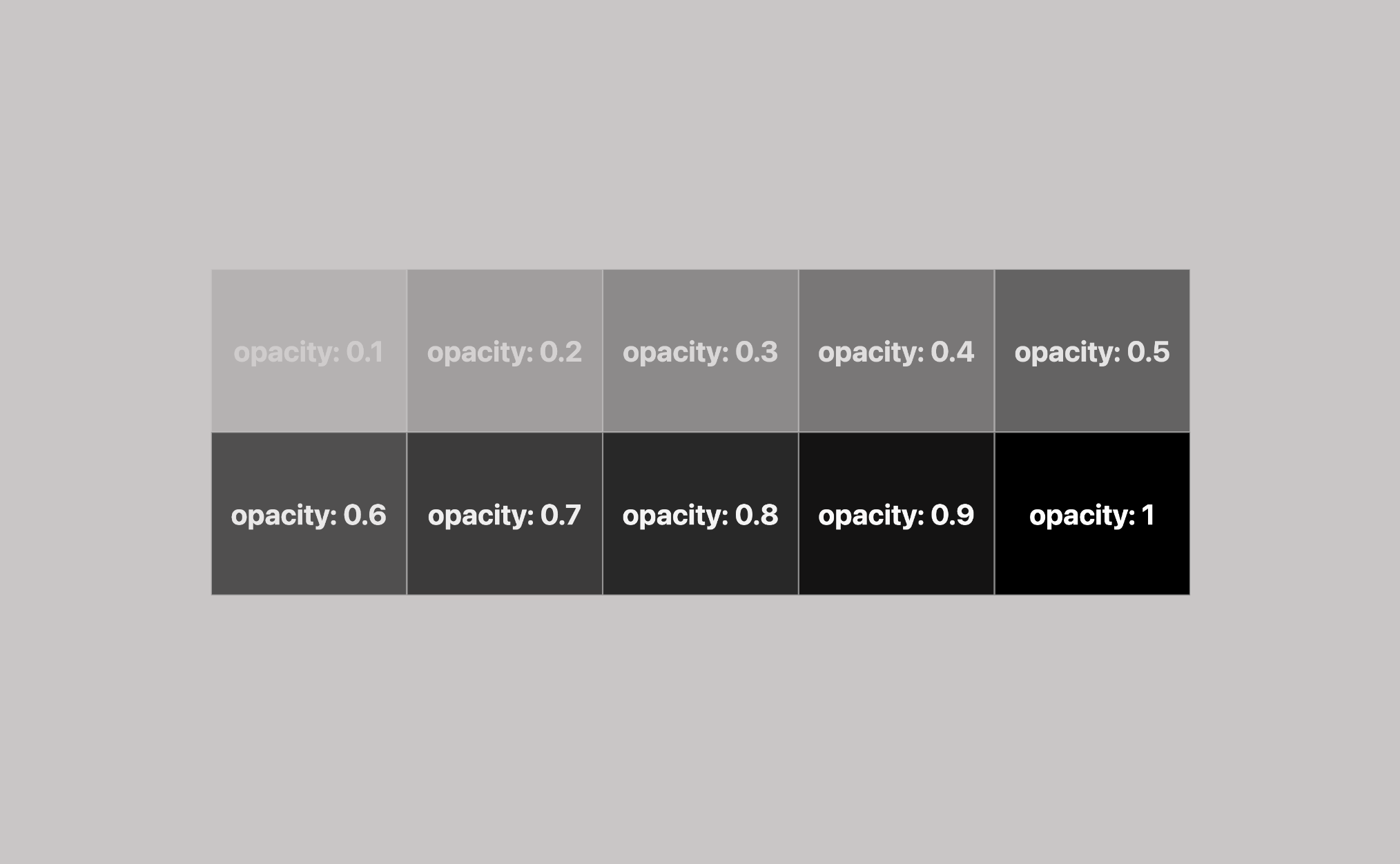
    As we can see, the resulting color of our child element will be a mix of white, influenced by the grey ⬜ background color.

    .parent {
      background-color: grey;
    }
    
    .child {
      color: black;
      background-color: white;
      opacity: 0.1; // depending on the value //
    }
    CSS
    An image showing a table with 10 blocks. Each block shows the CSS opacity filter starting from 0.1 to 1

    CSS Opacity: Effects on HTML Elements with Orange Backgrounds

    As observed, the child’s resulting color will be a blend of white, affected by the orange 🟧 background color.

    .parent {
      background-color: orange;
    }
    
    .child {
      color: black;
      background-color: white;
      opacity: 0.1; // depending on the value //
    }
    CSS
    An image showing a table with 10 blocks. Each block shows the CSS opacity filter starting from 0.1 to 1.

    CSS opacity offers a powerful way to control transparency, influencing how the background colors of parent elements interact with those of child elements. Understanding these interactions can help create visually appealing designs where colors harmoniously blend across different layers. 🌈 ✨

  • Drop-shadow VS Box-shadow: What is the difference?

    Drop-shadow VS Box-shadow: What is the difference?

    Greetings 😃 In today’s session, we’re about to explore 🔎 the fascinating world of the CSS shadow properties. Get ready to unlock 🗝 the secret between CSS drop-shadow and box-shadow properties!

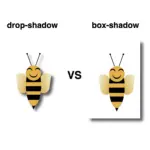
    I created a beautiful, playful bee 🐝 to make our example understandable and funny! You can check out my “bee code” at the end of my post and see how I created it. You are welcome to use it wherever suits you!

    CSS box-shadow

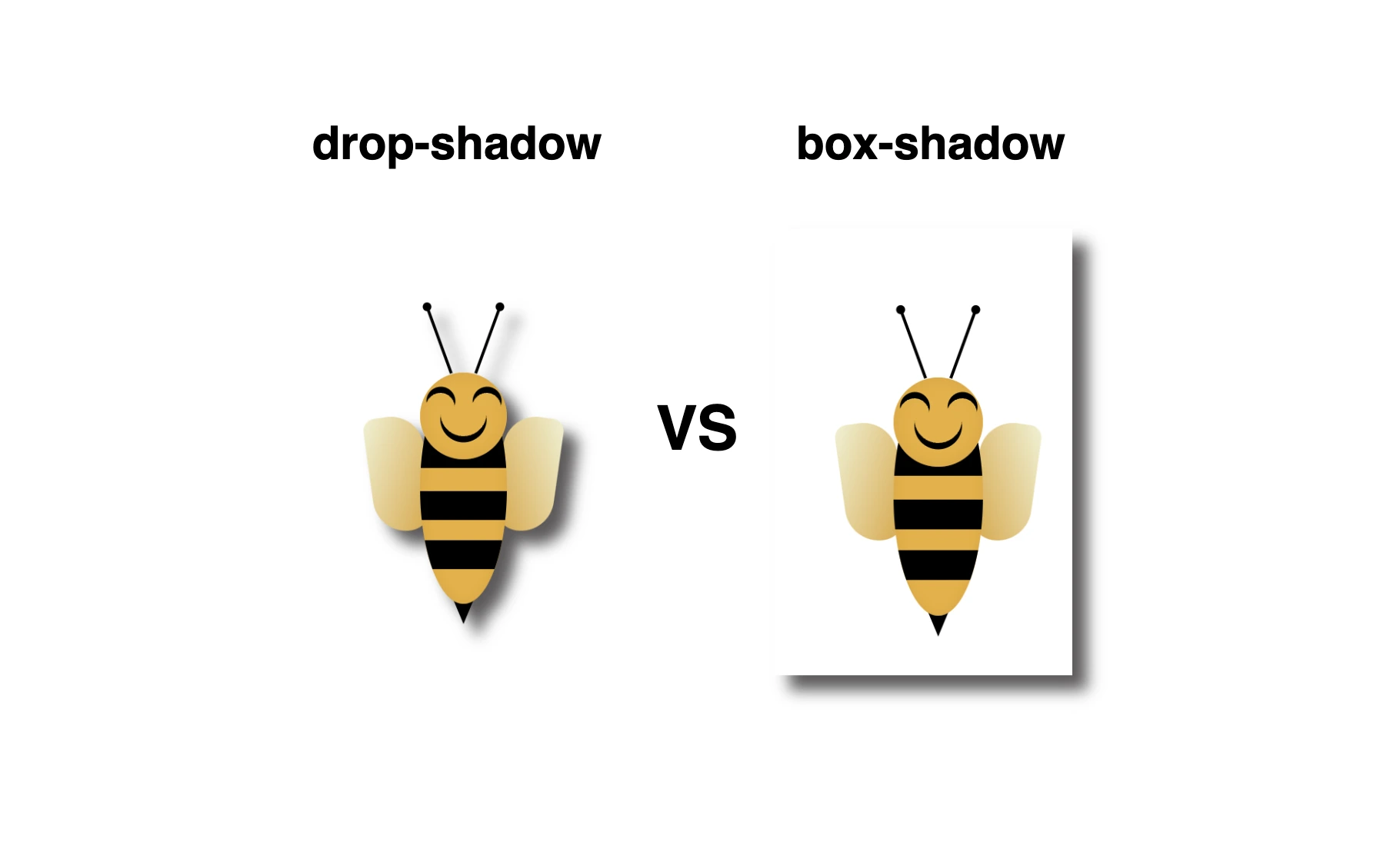
    Now, let’s focus on our shadows! In the following example, we see the effect of the box-shadow property. Our shadow is applied to the two sides of our box (bee-wrapper). The code I provided creates a gray shadow with the following characteristics:

    .bee-wrapper {
      ...
      /* offset-X | offset-Y | blur-radius | spread-radius | color */
      box-shadow: 10px 10px 10px 0 #5b5959;
    } 
    CSS
    • offset-X: adds 10 pixels to the right of the element.
    • offset-Y: adds 10 pixels below the element.
    • blur-radius: A blurry shadow with a radius of 10 pixels. (You are free to use a higher blur radius for a softer, more diffuse shadow, or you might opt for a lower blur radius to create a sharper, crisper shadow).
    • spread-radius: The shadow doesn’t expand or contract beyond the blur radius as I set it to zero. (I chose not to add spread, but it’s totally up to you if you want to add it.
      🔖 Keep in mind that the spread-radius parameter determines whether the shadow expands or reduces in size. A positive value will enlarge the shadow, whereas a negative value will shrink it).
    • color: The color of the shadow is a shade of gray (#5b5959).
    Comparison between box-shadow and drop-shadow CSS properties.This is the box shadow property

    CSS drop-shadow

    In this case, on the other hand, we can see that by setting the filter: drop-shadow() property the shadow applies smoothly to all parts of our content inside the box (bee-wrapper). Cool 🥳 ha! So, let’s see our code in more detail and how the shadow will now be rendered on the screen through our lovely bee!

    .bee-wrapper {
      ...
    /* offset-X | offset-Y | blur-radius | color */
    filter: drop-shadow(10px 10px 5px #5b5959);
    }
    CSS
    • filter: The filter property in CSS applies various graphical effects, including blurs, color adjustments, and, in this instance, shadows, to an element.
    • offset-X: This specifies the horizontal offset of the shadow from the element. It’s 10 pixels to the right, creating a shadow on the right side of the element.
    • offset-Y: This specifies the vertical offset of the shadow from the element. It’s 10 pixels below the element, creating a shadow below it.
    • blur-radius: A moderately blurry shadow with a radius of 5 pixels. (A higher value would create a more diffused and softer shadow, while a lower one would create a sharper shadow).
    • color: The shadow’s color is a shade of gray (#5b5959).

    🔖 It is worth mentioning that spread-radius property does not appear here.

    Comparison between drop-shadow and box-shadow CSS properties. This is the drop shadow property

    Complete bee code

    Below, I include my HTML and CSS bee code.

    <div class="bee-wrapper">
      <div class="face">
        <div class="antenna antenna--left"></div>
        <div class="antenna antenna--right"></div>
        <div class="bee-eye bee-eye-left"></div>
        <div class="bee-eye bee-eye-right"></div>
        <div class="bee-mouth"></div>
      </div>
      <div class="wing wing--left"></div>
      <div class="wing wing--right"></div>
      <div class="sting"></div>
      <div class="bee-body">
        <div class="stripes"></div>
      </div>
    </div>
    HTML
    Expand
    :root {
      --bg-color: #cdc6c7;
    }
    
    * {
      margin: 0;
      padding: 0;
      box-sizing: border-box;
    }
    
    html,
    body {
      height: 100%;
    }
    
    body {
      min-width: 300px;
      background-color: var(--bg-color);
      display: flex;
      flex-direction: column;
      align-items: center;
      justify-content: center;
    }
    
    // BEE
    .bee-wrapper {
      position: relative;
      width: 200px;
      height: 300px;
      
                /* BOX-SHADOW */
      /* uncomment to see the box-shadow effect
      * offset-x | offset-y | blur-radius | spread-radius | color
      */
      // box-shadow: 10px 10px 10px 0 #5b5959;
      
                /* DROP-SHADOW */
      /* uncomment to see the drop-shadow effect
      * x-offset | y-offset | blur | color
      */
      // filter: drop-shadow(10px 10px 5px #5b5959);
      
      .face {
        position: absolute;
        width: 60px;
        height: 60px;
        background-color: #ecaf2f;
        box-shadow: inset 0 0 10px #dda22c;
        border-radius: 50%;
        z-index: 20;
        top: 100px;
        left: 80px;
        .antenna {
          position: absolute;
          width: 2px;
          height: 50px;
          background-color: black;
          &--left {
            top: -48px;
            left: 12px;
            transform: rotate(-20deg);
            &:after {
              content: "";
              position: absolute;
              width: 6px;
              height: 6px;
              background-color: black;
              border-radius: 50%;
              top: -2px;
              left: -2px;
            }
          }
          &--right {
            top: -48px;
            right: 12px;
            transform: rotate(20deg);
            &:after {
              content: "";
              position: absolute;
              width: 6px;
              height: 6px;
              background-color: black;
              border-radius: 50%;
              top: -2px;
              right: -2px;
            }
          }
      }
        .bee-eye {
          position: absolute;
          width: 20px;
          height: 20px;
          border-radius: 50%;
          box-shadow: 3px 3px 0 0 black;
          transform: rotate(230deg);
          &.bee-eye-left {
            top: 14px;
            left: 4px;
          }
          &.bee-eye-right {
            top: 14px;
            right: 4px;
          }
      }
        .bee-mouth {
          position: absolute;
          width: 32px;
          height: 32px;
          border-radius: 60%;
          box-shadow: 3px 3px 0 0 black;
          top: 12px;
          left: 14px;
          transform: rotate(45deg);
        }
      }
    
      .wing {
        position: absolute;
        width: 40px;
        height: 80px;
        &--left {
          background-image: linear-gradient(to bottom right, #f0f1d2, #dda22c);
          border-radius: 30px 80px 60px 80px;
          transform: rotate(352deg);
          top: 130px;
          left: 45px;
        }
        &--right {
          background-image: linear-gradient(to bottom left, #f0f1d2, #dda22c);
          border-radius: 80px 30px 80px 60px;
          transform: rotate(8deg);
          top: 130px;
          left: 135px;
        }
      }
    
      .bee-body {
        position: absolute;
        width: 60px;
        height: 160px;
        border-radius: 50%;
        background-color: #ecaf2f;
        box-shadow: inset 0 0 8px #dda22c;
        overflow: hidden;
        top: 100px;
        left: 80px;
          .stripes {
          position: absolute;
          width: 80px;
          height: 22px;
          background-color: black;
          border-radius: 10px;
          top: 44px;
          left: 50%;
          transform: translate(-50%);
          &:before {
            content: "";
            position: absolute;
            width: 80px;
            height: 20px;
            background-color: black;
            border-radius: 10px;
            top: 38px
          }
          &:after {
            content: "";
            position: absolute;
            width: 80px;
            height: 20px;
            background-color: black;
            border-radius: 10px;
            top: 72px;
          }
        }
      }
    
      .sting {
        position: absolute;
        width: 0;
        height: 0;
        border-left: 10px solid transparent;
        border-right: 10px solid transparent;
        border-top: 24px solid black;
        top: 250px;
        left: 100px;
      }
    }
    CSS
    Expand
  • The CSS Sepia Filter – Learn How to Make Vintage Images

    The CSS Sepia Filter – Learn How to Make Vintage Images

    In the world of web design, adding a touch of nostalgia or a vintage vibe to images can significantly enhance a website’s aesthetic. One timeless technique to achieve this effect is the CSS sepia filter.

    Originating from sepia ink, which has been used for centuries, this filter gives photos a warm, brownish tone reminiscent of old photographs, lending a sense of history and charm to the visuals.

    An image with 0% sepia maintains its original, true colors, while at 100% sepia, the image is entirely transformed into a warm, brownish tone as an aged photograph. As you increase the percentage, you intensify the sepia effect.

    Join me 😃 into the magic of the filter: sepia(%) CSS property and explore how it can be seamlessly integrated into your web design toolbox.

    History of the sepia ink

    🧐 Did you know that sepia ink is a brownish-black ink made from the ink sac of the common cuttlefish, Sepia? 🐙 They belong to the class Cephalopoda, which also includes squid, octopuses, and nautiluses.

    Historically, it has been used for writing and drawing, and it was particularly popular in the past for writing manuscripts and creating artwork.

    The ink took its name from the sepia cuttlefish, which was the source of the ink. The ink was widely used in antiquity and during the Renaissance*, and it has a characteristic warm, brownish hue which is why the CSS filter that replicates this effect is referred to as the “sepia” filter.

    (* The Renaissance was a period in European history that spanned roughly from the 14th century to the 17th century. It was characterized by a significant cultural, artistic, and intellectual rebirth after the Middle Ages. The term “Renaissance” is derived from the French word meaning “rebirth”).

    Use the CSS sepia filter to an image

    Below I craft an example as an easy way to explain this amazing CSS property to you! 😃 So, let’s proceed.

    We will start with our HTML and CSS code snippets.

    The HTML snippet contains two <img> elements. The first one has the .original-image class, indicating a standard image. The second one has also the .original-image and additionally the .with-sepia, implying it’s a styled image using the sepia filter, giving it a warm, brownish tone.

    <img class="original-image"/>
    <img class="original-image with-sepia"/>
    HTML

    The .original-image class is shared by both image elements, setting a background image, ensuring it doesn’t repeat and covering the specified width and height (400px by 500px).

    The .with-sepia class applied only to the second image, introduces a sepia filter of 80%, giving a warm, brownish tone.

    .original-image {
      background-image: url(https://images.unsplash.com/photo-1501829385782-9841539fa6bf?ixlib=rb-4.0.3&ixid=M3wxMjA3fDB8MHxwaG90by1wYWdlfHx8fGVufDB8fHx8fA%3D%3D&auto=format&fit=crop&w=3024&q=80);
      background-repeat: no-repeat;
      background-size: cover;
      width: 400px;
      height: 500px;
    }
    
    .with-sepia {
      filter: sepia(80%);
    }
    CSS

    By placing the two images side by side, we can effortlessly 🧐 perceive the contrast between them. It’s absolutely fascinating, isn’t it? 😃

    Enrich filter CSS sepia property with grayscale value

    In addition, we can add the filter: grayscale(%) CSS property. Together, these filters can create a unique and visually captivating presentation, capturing the essence of both the past and the present in a single frame.

    .with-sepia {
      filter: sepia(80%) grayscale(50%);
    }
    CSS

    Wow! 🌟 This is absolutely stunning! 😃

  • How to Make Grayscale Images with CSS

    How to Make Grayscale Images with CSS

    Transforming your images into stunning black-and-white tones with depth and texture has become easier than ever with the powerful grayscale filter. Adding a touch of gray to your images creates a modern vibe and turns them into art. To achieve this effect, we use the CSS filter: grayscale(%) property.

    The grayscale filter allows you to adjust the percentage of gray. When you increase the percentage, you boost the effect. An image with 0% grayscale maintains its authentic colors, while at 100% grayscale, the image is entirely transformed into a cold, grayish tone.

    Join me 😃 in the magic of the grayscale filter, explore how it can be merged harmoniously, and enhance your techniques.

    Monochrome – Grayscale method

    The grayscale method, or in other words, monochrome photography method, captures and displays different levels of light but not different colors. It includes all forms of black-and-white photography, which produces images with shades of gray ranging from black to white.

    It originated in 1820 when Nicephore Niepce, a French inventor and photographer, created the first photograph. In today’s world, monochrome photography is mainly used for applications other than photographs.

    Applying the grayscale filter to an image

    Below, I’ve prepared an example to help clarify this property for you! 😃 So, let’s move forward.

    We begin with our HTML and CSS code snippets.

    The HTML snippet includes three img elements. The first one has the .original-image class, indicating a standard image. The second and the third also have the .original-image plus the .with-grayscale class, meaning it’s a styled image using the grayscale filter, giving it a cold, grayish tone.

    <img class="original-image"/>
    <img class="original-image with-grayscale"/>
    <img class="original-image with-grayscale"/>
    HTML

    The .original-image class is applied to all image elements, setting a background image, ensuring no repetition, and covering the specified dimensions of 400px width and 500px height.

    The .with-grayscale class applied only to the second and third images, introduces a grayscale filter. In the second case, it is set at 50%, displaying our image with some grayish tones, while in the third case, it is set at 100%, decolorizing our image and declaring a completely gray tone.

    .original-image {
      background-image: url('...');
      background-repeat: no-repeat;
      background-size: cover;
      width: 400px;
      height: 500px;
    }
    
    .with-grayscale {
      filter: grayscale(50%);
    }
    
    .with-grayscale {
      filter: grayscale(100%);
    }
    
    CSS

    By positioning the three images side by side, we can clearly 🧐 observe the contrast among them. It’s absolutely captivating. Don’t you agree? 😃